

Tools and Technologies
Development and Debugging
- NXP S32 Design Studio: IDE for building applications on NXP automotive microcontrollers
- GCC ARM Compiler: Cross-compiler for generating embedded binaries
- Ozone Debugger: Used for analysing and optimizing embedded applications
- PE Micro Debugger: For flashing and debugging microcontrollers during hardware bring-up
Static Analysis and Testing
- Polyspace: Static code analysis for detecting runtime errors and ensuring coding standard compliance
- Tessy: Tool for unit and integration testing of embedded software
Lifecycle and Project Management
- CodeBeamer: Application lifecycle management tool for managing requirements, testing, and traceability
- Project Management Tool: Used for planning, execution, and tracking project milestones
Diagnostics and Communication Testing
- CANoe: For simulation and testing of LIN-based automotive communication
- PLIN Tool: Monitoring and testing LIN communication
- CAN/LIN Interface Hardware: For validating communication between the ECU and vehicle network
Hardware Platforms
- NXP Development Kit: Used for flashing, debugging, and testing embedded software
- Prototype Hardware (A-Sample and B-Sample): Custom hardware for different development stages
- Logic Analyzer: For capturing and analyzing digital signals during hardware validation
About the Customer
A global sensor manufacturer approached us with an innovative initiative. They wanted to improve in-cabin air quality in premium vehicles using real-time CO₂ monitoring.
While their sensors were already trusted by leading automotive brands, they needed intelligent software to integrate the sensor seamlessly with the vehicle’s existing systems and make the data truly actionable.
Supports 5+ Sensor types
Production Initiated for 1 Million Units
200+ automated test scenarios executed
Business Challenge
In a closed vehicle cabin, CO₂ levels can escalate rapidly, especially in urban traffic or during long drives with minimal ventilation. Elevated CO₂ levels are known to cause drowsiness, loss of concentration, and reduced driving safety.
The customer, a global sensor manufacturer, wanted to go beyond just accurate gas detection. Their goal was to deliver a real-time CO₂ monitoring solution that could enhance occupant comfort and safety in premium vehicles.
The solution needed to:
- Accurately measure cabin CO₂ levels using their proprietary sensor
- Transmit sensor data over the LIN bus to the HVAC or central ECU
- React dynamically to different driving conditions such as traffic, idle, or high speed
- Comply with automotive grade safety, EMC, and reliability standards
The real challenge was to develop a smart microcontroller-based interface that could:
- Interpret and add context to raw sensor data instead of simply relaying it
- Communicate seamlessly with the vehicle’s existing LIN network
- Support real-time vehicle diagnostics and error reporting
- Operate reliably under demanding automotive environmental conditions
The customer needed a trusted technology partner who could deliver not just embedded software, but a complete ECU platform that brings their sensor to life inside a modern vehicle.
Embitel's Solution
We developed the complete embedded software for the microcontroller that connects to the customer’s CO₂ sensor.
The microcontroller receivesd data from the sensor using I2C. It processesd this data and sendst it to the master ECU using LIN communication.
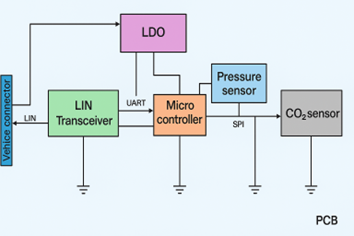
Key features of our solution included:
- State-based logic that changed data polling frequency depending on whether the car was running, idle, or parked
- LIN stack integration provided by the customer, adapted to work smoothly within our software
- Fault detection and diagnostics to monitor sensor status, CO₂ levels, and system performance
- Data conversion logic to translate raw sensor values into meaningful units
To support validation, we also built a custom software application that simulated high CO₂ levels and supported batch-based firmware flashing. This testing panel helped testers automate edge-case scenarios, improving the speed and accuracy of manual validation cycles.
The entire solution followed ASPICE CL2 processes and was delivered in three structured phases.
Embitel's Impact
the final phase, the software was stable and ready for production. Highlights included:
- No bugs at final delivery
- All earlier issues resolved and validated
- Seamless integration with customer hardware
- CL2 compliance across almost all ASPICE areas
The system was also scalable. It could easily be adapted to work with other sensors in the future.
