





site-logo

In-Vehicle Infotainment Validation & Testing

Modern vehicles rely heavily on In-Vehicle Infotainment (IVI) systems as a central interaction hub. Rigorous validation ensures these platforms integrate seamlessly with vehicle networks while maintaining performance, safety, and cybersecurity. Structured V&V safeguard both user experience and system reliability.

By adopting a structured and layered validation approach, functional, integration, performance, and safety risks are identified early. It aids in reducing field failures, improving system stability, and ensuring readiness for real-world deployment across automotive and industrial platforms.

Talk to our Automotive Testing Consultants

Service Offerings

functional-validation

Functional Validation Coverage

  • Head Unit validation (Android / Linux / Proprietary)
  • Smartphone projection validation (Android Auto / Apple CarPlay)
  • Navigation & location accuracy testing
  • Multimedia, audio & voice assistant validation
  • User profile persistence & personalization checks
integration

Vehicle Integration & Network Validation

  • CAN / CAN FD protocol validation
  • Ethernet & diagnostics testing
  • Sensor and camera data integration checks
  • Telematics & cloud synchronization validation
non-functional

Non-Functional Validation

  • Boot time & response time analysis
  • Load, stress & endurance testing
  • Memory leak & crash analysis
  • Security validation of connectivity interfaces
process-expertise

Process Expertise

  • Structured test strategy aligned with automotive quality standards
  • End-to-end traceability (Requirement → Test Case → Execution → Defect)
  • ASPICE-aligned V&V methodology
  • Collaboration with cross-functional hardware, software, and UX teams
FuSa

FuSa and Cybersecurity Compliance

Our IVI validation approach is aligned with global functional safety and cybersecurity standards defined by ISO.

End-to-end IVI validation services designed to ensure seamless system integration, enhanced user experience, safety compliance, and long-term performance stability across OEM and Tier-1 ecosystems.

Requirement Coverage Definition

Identification and analysis of functional requirements (Navigation, Privacy, Voice, Connectivity)

Non-functional requirements (Performance, Stability, Security)

Regulatory & compliance requirements

Mapping of requirements to test scenarios

Requirement Traceability Matrix (RTM)

Ensuring full feature coverage

Risk Assessment

Identification of safety-critical and high-impact areas

Impact analysis of potential failures on UX, system, or compliance

Prioritization of test focus based on risk levels

Mitigation strategies for high-risk features

Input for risk-based test planning

Test Planning

Test scope definition and status

Resource planning (Component, Integration + System + Vehicle)

Environment and tool selection

Definition of entry & exit criteria for each phase

Approval of test strategy

Test Design & Environment Setup

Test scenario and test case development

Automation feasibility and script preparation (Bench + Function)

Test data preparation

Smoke test for build readiness

Test Execution

Functional, integration, and system testing across platforms

Performance, stability, and stress testing

Edge-case and boundary condition testing

Network & connectivity validation (CAN, Ethernet, Bluetooth)

Logging, defect identification, and triage

Regression & Release Validation

Regression testing of impacted areas

Automated regression execution

KPI monitoring (pass rates, defect density)

Release readiness assessment

Reporting & Governance

Test coverage and metrics tracking

Defect lifecycle management and root cause analysis

Status reporting (daily/weekly)

Quality gate reviews

Final validation sign-off and documentation

As part of Embitel’s Verification & Validation services, IVI testing efforts focus on key functional domains:

  • Head Unit (Android / Linux / Proprietary Platforms)
  • Display & HMI
  • Connectivity & Smartphone Projection
  • Navigation & Location Services
  • Multimedia & Audio Systems
  • Vehicle Integration & CAN Data
  • Connected & Cloud-Linked Services
  • Software Updates & Diagnostics
  • Performance, Security & Reliability
  • Telematics & Vehicle Connectivity
  • Camera & Video-Based IVI Integration
  • User Profiles & Personalization

Standard Metrics Block

  • Certified Engineers – (Input Required)
  • Certifications – (ISO 26262 / ASPICE / Security Certifications – Input Required)

System Architecture Overview

IVI validation follows a structured V-diagram methodology:

Requirement Definition → Feature Modeling → Integration Validation → System Testing → Compliance & Release Sign-off

The IVI system architecture typically includes:

  • Head Unit (Central Processing System)
  • Display & HMI Interface
  • Vehicle Network Interfaces (CAN / Ethernet)
  • Connectivity Modules (Bluetooth / Wi-Fi / USB)
  • Telematics & Cloud Backend
  • Camera & Sensor Inputs
1. HMI Layer
UI Screens
Rendering
UX Logic
Input Handling
2. Application Layer
Head Unit
Media & Audio
Navigation & Settings
Display
Connectivity & Phone
Camera
3. Framework Layer
System Services
Managers
IPC
Security
4. HAL Layer
Vehicle HAL
Audio HAL
Display HAL
Power HAL
5. Device Drivers
CAN Driver
Touch Driver
Display Driver
Audio
6. MCU Layer
Power Control
Watchdog
Real-time I/O
CAN Ctrl
7. Hardware
SoC
GPU
DSP
CAN Transceiver
Displays

Testing is performed across modular, scalable, and centralized architecture models depending on OEM platform design.

IVI Testing Workflow

Requirement Coverage

Functional requirements (Media, Navigation, Phone, Voice, Connectivity) and non-functional requirements (Performance, Stability, Security, UX/HMI) are systematically mapped into a Requirement Traceability Matrix (RTM) to ensure complete feature coverage.
Test Design

Comprehensive test cases are developed covering:

  • Positive scenarios (expected behaviour)
  • Negative scenarios (error handling & failure modes)
  • Edge cases (boundary conditions & extreme inputs)
  • Protocol validation (CAN, Ethernet, diagnostics)
  • Automation-ready scripts for regression efficiency

Test Execution

Validation includes:

  • Feature-level functional testing
  • Integration testing across subsystems
  • System-level end-to-end validation
  • Performance, load, stress, and stability testing
  • Fault-handling and recovery verification

All defects are logged, categorized by severity, and analysed for root cause.

Defect Management

  • Detailed defect logging with reproduction steps
  • Severity classification (Critical / Major / Minor)
  • Lifecycle tracking (Open → Assigned → Fixed → Retest → Closed)
  • Triage meetings and root cause collaboration

Regression Testing

Automated regression suites are executed after every build update to validate fixes and prevent feature breakage across multimedia, navigation, connectivity, and vehicle integration layers.

Reporting & Documentation

  • Test coverage and execution reports
  • Defect analytics & trend metrics
  • Quality gate reviews
  • Final validation report with compliance traceability

In-Vehicle Infotainment Customer Success Stories

Development of an Invite-Only Website with Progressive Web App for a Leading F&B Retailer

Dual-display Android Infotainment Solution Development for an Electric Vehicle Startup

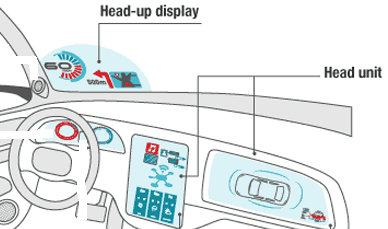
A dual-display Android infotainment system for a US-based electric vehicle startup, including a rapid POC and production-grade solution was in demand. We selected NXP i.MX6 hardware to support a 15” central display and a customizable head-up display (HUD). Delivered the prototype in under 3 months with CAN integration, smartphone connectivity, navigation, and advanced UI features. Solution powered by Android 7.1 with reusable components, ensuring speed, security, and seamless vehicle network integration.

SCADA Solution Development for Solar Tracking System

Execution of Preliminary HARA for Commercial Vehicle Instrument Cluster & Telematics System

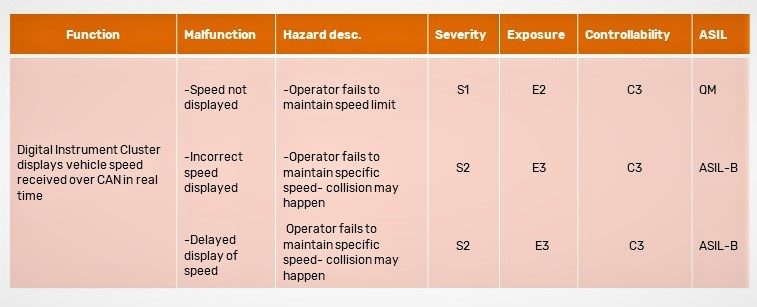
A US-based electric commercial vehicle manufacturer needed ISO 26262 compliance for its digital instrument cluster and telematics system. Embitel performed a cost-effective preliminary HARA to determine the appropriate ASIL level. Hazards were analysed based on severity, exposure, and controllability, leading to an ASIL-B classification. This early clarity helped the customer plan a safety-compliant development roadmap efficiently

Across IVI Validation Stages, How Does Our V&V Team Support Safety, Quality, and Compliance Goals?

Goal Design & Integration Stage System Testing Stage Release & Compliance Stage
Safety Validates distraction-free HMI design Ensures stable operation under driving conditions Supports emergency call (eCall/bCall) validation & compliance
Quality Verifies feature requirements Confirms integration reliability & performance Ensures long-term stability & update readiness
Compliance Provides requirement traceability Validates diagnostics & protocol conformance Generates compliance-ready documentation

Functional Test Levels

  • Unit Testing
  • Integration Testing
  • System Testing
  • Regression Testing
  • Vehicle-Level Testing
  • Sanity & Smoke Testing

Non-Functional Test Levels

  • Performance Testing
  • Load Testing
  • Stress Testing
  • Stability Testing

Automated Testing & Tooling Solutions

We bring strong hands-on experience across a wide range of testing tools and automation frameworks, enabling consistent, high-quality validation across IVI programs.

Test Automation & Scripting

  • Python
  • CAPL


Requirement Management

  • IBM DOORS
  • CodeBeamer


Vehicle Network Automation

  • CAPL-based automated signal validation

Embedded & Network Validation


Test Management & CI/CD

  • JIRA / KPM
  • Jenkins
  • Git


Logging & Debugging

  • ESOTracer
  • ADB Commands
  • Android Studio
  • Trace32


HMI / UI Automation

  • Python-based automation
  • Appium / UI Automator

Why Choose Embitel as Your IVI Testing Partner?

20+ years of embedded and automotive electronics expertise

Deep domain experience across infotainment, connectivity, and telematics

Scalable automation frameworks reducing regression effort

Structured, ASPICE-aligned validation processes

Flexible integration into OEM and Tier-1 ecosystems

Scroll to Top