





site-logo

Automotive ADAS - Driver Monitoring System (DMS) Validation & Testing

image-creation-for-Sreedevi-web-page-V1-copy-swathi-exp-2

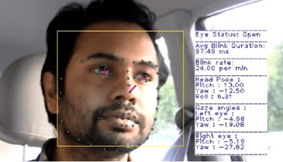
As a critical component of modern Advanced Driver Assistance Systems (ADAS), Driver Monitoring Systems (DMS) play a central role in enhancing road safety and supporting semi-autonomous driving functions.

Embitel's DMS Verification, Validation, and Testing services ensure that driver state detection algorithms, embedded software, and hardware platforms perform accurately, reliably, and safely under real-world operating conditions.

Through structured validation methodologies and simulation-based testing, potential functional, performance, and safety risks are identified early. Real-world data analysis further strengthens validation. This ensures compliance with global NCAP expectations, ISO standards, and OEM-specific requirements before deployment.

As part of Embitel's Verification & Validation services, DMS testing efforts focus on:

  • IR-based camera performance under varying lighting conditions
  • False positive / false negative rate analysis
  • Alert effectiveness and user experience validation
Talk to our Automotive Testing Consultants

Service Offerings

End-to-end Driver Monitoring System validation services designed to ensure detection accuracy, safety compliance, algorithm robustness, and reliable deployment across passenger vehicles, commercial fleets, and industrial systems.

Requirement Analysis

Collect system and software requirements from OEM/Tier-1
Identify functional (drowsiness, distraction detection) and non-functional (latency, robustness) requirements
Define coverage scope for V&V

Test Strategy & Planning

Define test levels:
  • MIL - Algorithm/model verification
  • SIL - Software verification
  • HIL - ECU/hardware integration verification
Decide manual vs automated testing for each level
Define fault injection and edge case testing strategy
Define entry/exit criteria for each V&V stage

Test Case Development

Create functional, integration, regression, and safety-critical test cases
Map each test case to specific requirements for traceability
Include test scenarios for:
  • Lighting variations (day/night/IR)
  • Driver variations (glasses, masks, head movement)
  • Edge cases (drowsiness onset, distraction recovery)

Test Data Acquisition

Collect real-world driver data using cameras and test bucks
Generate synthetic or augmented data for rare or extreme scenarios
Prepare input files for automated regression testing

Test Execution Strategy

Plan execution order (MIL ? SIL ? HIL)
Decide which scenarios to execute manually vs automated
Monitor real-time behaviour and capture logs for analysis

Defect Management & Re-Testing

Log defects with evidence in JIRA or similar tools
Perform root cause analysis and re-test after fixes
Maintain traceability from defect to requirement

Reporting & Compliance

Generate requirement coverage, pass/fail metrics, and execution reports
Provide evidence for ISO 26262, SOTIF, and OEM audits
Document lessons learned for future projects

Case Studies

Testing Workflow

Model-Based Design & Early Validation (Where Applicable)

At the early stage, algorithm models for gaze tracking, drowsiness detection, and head pose estimation are validated within simulation environments. This enables evaluation of detection logic, performance thresholds, and system response behaviour before production code integration.

Software-Level Validation

Production-level DMS software is verified against functional and non-functional requirements, including:

  • Detection accuracy
  • Latency
  • Robustness across driver variations
  • Edge case handling

Validation is performed in host environments and integrated test setups to ensure algorithm stability before ECU deployment.

Hardware & System-Level Validation

At the system level, the complete DMS stack including camera modules, ECU, network interfaces, and alert mechanisms is validated under near-production conditions. This includes:

  • Real-time video stream processing
  • IR camera performance validation
  • ECU response timing
  • Network communication checks
  • Fault injection and robustness testing

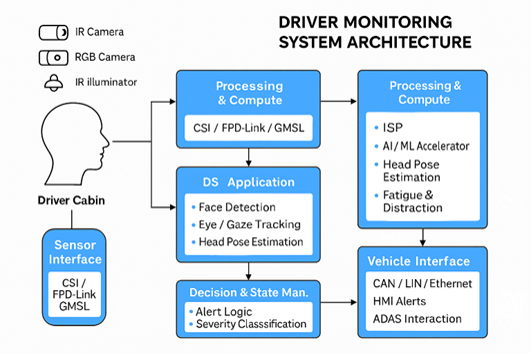
System Architecture Overview

system-architecture

The DMS validation process follows a structured V-diagram methodology:

Requirement Definition ? Algorithm Modeling ? Software Verification ? ECU Integration ? System Validation ? Compliance & Documentation

The system architecture typically includes:

  • IR Camera Module
  • DMS ECU / Processing Unit
  • Network Interfaces (CAN / Ethernet)
  • Alert Mechanisms (Visual / Audio / Haptic)
  • Cloud / Backend Interfaces (if applicable)

Testing Workflow:

  • Requirement Traceability Setup
  • Algorithm Simulation & Validation
  • Software-Level Verification
  • ECU & HIL Testing
  • Real-World Data Validation
  • Regression & Compliance Reporting

Technical Insights and Our Expertise

Digital Experience

Algorithm & Software Verification

  • Validation of driver state detection algorithms (drowsiness, gaze tracking, head pose estimation)
  • Verification of both functional and performance requirements
  • Latency and detection accuracy measurement
  • Regression validation for software stability
Cloud Computing

Data Acquisition & Processing

  • Real-world driver data capture using IR cameras, test buck setups, and OEM video streamers
  • Data preprocessing to address occlusion, lighting variation, glasses, masks, and driver diversity
  • Performance evaluation using detection accuracy, latency, false positives, and false negatives
IoT

System-Level & HIL Validation

  • HIL-based validation of DMS ECU behaviour
  • Simulation of real-world and edge-case scenarios
  • Fault injection for robustness and safety evaluation
  • Validation of alert effectiveness and driver feedback mechanisms
IoT

Process Expertise

  • Structured requirement-based and coverage-driven test case design
  • End-to-end traceability (Requirement -> Test Case -> Execution -> Defect)
  • ASPICE-aligned development and validation processes
  • Safety-compliant documentation and audit support
IoT

ISO Standards Followed

DMS validation aligns with global automotive safety and security standards defined by the International Organization for Standardization:

  • ISO 26262 - Functional Safety
  • ISO 21448 - Safety of the Intended Functionality (SOTIF)
  • ISO 14229 - Unified Diagnostic Services (UDS)
  • ISO 11898 - Controller Area Network (CAN)

How Does Our V&V Team Support Safety, Quality, and Compliance of our DMS services?

Goal Design & Algorithm Stage Software Stage System & ECU Stage
Safety Validates detection logic for fatigue and distraction Tests edge cases, fault scenarios, robustness Validates real-time detection and alert response under near-production conditions
Quality Ensures requirement alignment at model level Confirms detection accuracy, latency, regression stability Verifies integration of camera, ECU, and alert systems
Compliance Provides traceability to ISO 26262 & SOTIF Validates safety logic implementation Generates compliance-ready documentation and audit artifacts

Automated Testing & Tooling Solutions

Modern DMS platforms require scalable and repeatable validation. Our automated testing ecosystem accelerates time-to-market while improving detection accuracy and regression efficiency.

Model-Based & Simulation Platforms

  • HIL setups
  • Simulation environments
  • OEM-specific video streamers
Test Management & CI/CD

  • JIRA / JAMA - Requirement and test management
  • Jenkins - Automated pipeline-based execution
  • GitHub / GitLab - Version control and integration
Automation & Data Analysis

  • Python-based automated test case development
  • Automated regression execution
  • Detection performance analytics
  • False positive / false negative trend analysis
Network & ECU Tools

  • Ethernet validation tools
  • CAN communication tools
  • Cloud validation (AWS-based environments, if applicable)

Why Choose Embitel as Your DMS Testing Partner?

Deep expertise in ADAS, embedded systems, and safety-critical validation

2 decades of Industry experience

  • Structured ASPICE-aligned processes
  • Proven capability in ISO 26262 & SOTIF compliance support
  • Flexible toolchain integration with OEM ecosystems
  • Scalable automation frameworks accelerating validation cycles
adult-person-working-home-late-night-1-2

FAQs

Ans. DMS testing validates that driver state detection algorithms such as drowsiness, distraction and gaze tracking etc. function accurately, reliably, and safely under real-world operating conditions.

Ans:DMS ensures driver readiness in semi-autonomous vehicles, reduces accident risk, and supports compliance with ISO 26262 and SOTIF requirements.

Ans.Automation enables high-volume scenario execution, regression stability testing, and rapid performance benchmarking—reducing validation time and improving detection reliability.

Ans.DMS validation covers real-world and edge-case scenarios such as low-light driving, sunglasses usage, facial occlusion, head rotation angles, multi-ethnic facial features, vibration conditions, and extreme cabin lighting variations.

Ans.Testing includes simulations and controlled validations for varying illumination levels (day/night/tunnel), infrared interference, temperature variations, vehicle motion, and cabin reflections to ensure consistent detection accuracy.

Ans. HIL testing enables real-time validation of DMS ECUs by simulating vehicle signals and driver behaviours, ensuring embedded software performance under dynamic operating conditions without requiring full vehicle prototypes.

Ans.Through extensive dataset training, algorithm tuning, corner-case scenario testing, and regression automation, validation teams measure detection confidence levels and refine thresholds to balance sensitivity and robustness.

Ans. Key metrics include detection accuracy rate, latency, gaze tracking precision, drowsiness detection time, false alarm rate, system response time, and overall functional safety compliance.

Ans. Validation ensures adherence to ISO 26262 (Functional Safety), SOTIF (ISO 21448), UNECE regulations, and OEM-specific safety requirements through structured verification, traceability, and documentation.

Ans. Yes. Using synthetic data, scenario-based simulation, recorded driver datasets, and AI-based driver emulation tools, large portions of validation can be automated before physical road testing.

Ans. Model validation includes dataset bias analysis, training-validation split evaluation, robustness testing across demographics, explainability checks, and performance benchmarking against defined KPIs.

Ans. Common challenges include algorithm bias, occlusion handling, lighting variability, computational latency on embedded hardware, camera calibration accuracy, and integration with ADAS/vehicle networks.

Ans. Revalidation is required after algorithm updates, hardware changes, camera position modifications, or regulatory updates to ensure continued compliance and performance consistency.

Ans. Verification confirms that the system is built correctly according to design specifications, while validation ensures the system performs correctly under real-world usage conditions.

Scroll to Top