Expertise
With 20 years of experience in automotive electronics, embedded systems, verification, validation and testing - we bring unmatched expertise to every project.


As an integral part of the verification, validation, and testing process, Hardware in the Loop (HIL), Software in the Loop (SIL), and Model in the Loop (MIL) testing services support systematic testing across the development lifecycle.
A layered MIL, SIL, and HIL approach helps catch issues early, before they become costly risks, and keeps development moving faster.
It builds confidence in every release, ensuring reliable performance in real world automotive and industrial environments.
Our testing efforts focus on key functional domains that are critical to vehicle performance, user experience, and safety:
Embitel provides automotive MIL, SIL, and HIL testing services to validate ECUs, helping teams build safer (FuSa), secure (cybersecurity) systems ready for real world deployment.
Model in the Loop or MIL testing is performed at the early design stage to validate control algorithms using mathematical and behavioural models within a simulation environment. This approach allows verification of system logic and control strategies before software implementation or hardware availability.
Software in the Loop or SIL testing validates auto-generated or manually developed production code by executing it on a host environment. The software behaviour is verified against functional and performance requirements, enabling early detection of software-level issues without dependency on target hardware.
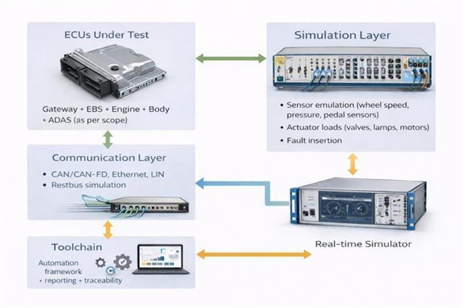
Hardware in the Loop or HIL testing represents the final dynamic verification phase, where actual controller or ECU hardware is tested against a real-time simulated plant model. This enables validation of timing constraints, I/O behaviour, network communication, and fault responses before system-level or vehicle-level validation.
Define overall testing objectives, scope, and levels: MIL → SIL → HIL
Determine the type of testing at each level: functional, integration, regression, fault injection
Establish entry and exit criteria for each stage
Assign responsibilities and define resources required
Identify tests suitable for automation vs manual execution
Develop regression suites to ensure repeatability
Maintain version control and configuration management for tests, models, and code
Map system and software requirements to test cases
Define coverage metrics: functional, safety-critical, boundary, and edge cases
Ensure traceability from requirements → test cases → results
Identify risk areas for fault injection or robustness testing
Define readiness to progress from MIL → SIL → HIL
Set criteria for completion: pass rate, defect closure, coverage achieved
Ensure results are reviewed and approved before moving to the next stage
Identify safety-critical functions and assess risks
Plan fault injection or boundary testing to verify system robustness
Ensure alignment with safety standards (e.g., ISO 26262, SOTIF)
Capture results, KPIs, and coverage statistics
Document defects, anomalies, and corrective actions
Provide traceability evidence for audits and regulatory compliance
Ensure stakeholder visibility
Define the test environment for each level:
Select tools for automation, logging, and reporting
Plan integration with CI/CD pipelines if applicable

Development of an integrated simulation environment by building a TruckSim-based vehicle dynamics plant model and a Simulink steering controller supporting both guided and manual modes. Sensor and actuator placeholders were modeled in Simulink, with full Software-in-the-Loop (SIL) validation performed by running the controller against the plant model, including animation and interface development.
Executed for a UK-based Tier 2 supplier using Simulink, Stateflow, and TruckSim.
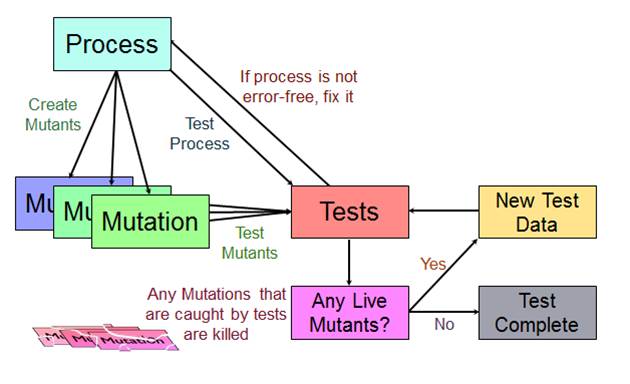
An established European automotive engineering company required a specialized partner to perform mutation testing on its EPS ECU software to achieve ASIL D compliance under ISO 26262 within stringent launch timelines. Embitel leveraged its deep expertise in Advanced C and automotive embedded systems to design 100% coverage test cases, execute and analyze mutant code scenarios, and ensure all safety-critical requirements were met—successfully supporting the customer’s functional safety certification goals.
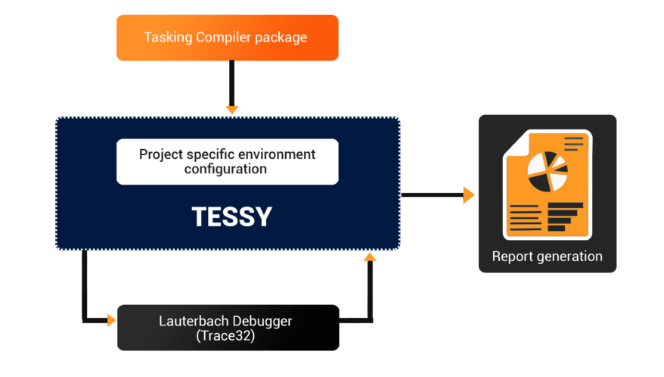
Partnership with a Tier-1 automotive supplier to implement automated unit testing for Body Control Module software components, including CAN, LIN, UDS stacks, and low-level drivers. Using the Tessy automation tool, we delivered comprehensive coverage reports (Statement, Branch, MCDC) while reducing testing effort from 8 man-hours to 2 per module. The engagement improved accuracy, ensured OEM-compliant reporting, and strengthened the customer’s product validation capability.
| Goal | MIL Contribution | SIL Contribution | HIL Contribution |
| Safety |
|
|
|
| Quality |
|
|
|
| Compliance | Provides traceability for ISO 26262 | Verifying that the generated code meets safety standards (e.g., ISO 26262, DO-178C) |
|
Modern embedded and software-intensive systems require structured, automated, and tool-driven validation to ensure speed, accuracy, and repeatability. Our automated testing ecosystem combines industry-standard platforms with in-house frameworks to accelerate verification cycles, improve coverage, and ensure consistent quality across MIL, SIL, and HIL environments.
These tools enable creation of virtual environments and dynamic plant models to support MIL, SIL, and HIL-based validation strategies.
By integrating validation into CI/CD pipelines, we enable faster and more reliable software releases.
This supports adherence to functional safety standards and improves system resilience.
These frameworks enable efficient test creation, structured execution, and real-time validation of ECU software.
This enables efficient issue diagnosis and root cause analysis.
These tools extend automation beyond ECU validation to connected and user-facing systems.
This ensures complete validation coverage and alignment with functional safety and compliance standards.
In addition to our in-house expertise, we seamlessly adopt customer-provided tools and environments. This ensures smooth integration into existing ecosystems while accelerating automation deployment and improving execution efficiency.
This ensures robust validation under near-production conditions.
With 20 years of experience in automotive electronics, embedded systems, verification, validation and testing - we bring unmatched expertise to every project.
We stay ahead of the curve with continuous research and development, delivering innovative solutions that drive the future of electric mobility.
We partner closely with our clients, understanding their unique requirements and delivering tailor-made solutions that exceed expectations.
Our rigorous quality assurance processes ensure that every project we deliver meets the highest standards of performance, reliability, and safety.
Model-In-Loop (MIL), Software-In-Loop (SIL), and Hardware-In-Loop (HIL) testing together form a structured validation approach used across the development lifecycle of embedded and control systems.
Together, MIL → SIL → HIL testing ensures progressive risk reduction, faster development cycles, and higher system reliability before deployment.
By shifting validation to virtual and automated environments, MIL, SIL, and HIL testing enable teams to identify issues much earlier and run development activities in parallel rather than sequentially. This approach allows continuous, repeatable testing without waiting for physical prototypes, enabling round-the-clock execution of test cases. As a result, automotive and aerospace programs often see development cycle reductions in the range of 40% to 70%, along with a significant drop in the cost and effort associated with extensive road and field testing.
