Start today & join millions of thriving Shopify-ed enterprises
Why Grow your business with our Shopify website development services? - Shopify is the trusted partner for millions of merchants worldwide. Shopify is an all-in-one ecommerce platform that enables individuals and businesses to create, customise, and manage their online stores easily. It provides everything needed to sell products or services online, in person, and through social media without requiring advanced technical skills.
At Embitel, we specialize in Shopify customisation and Shopify store setup to provide scalable and affordable solutions for your online store. We are a certified Shopify partner which gives you an added layer of trust and reliability.
Store setup and design advisory- Website audit and suggested actions to
enhance your store setup like developing your collections, installing suggested
apps, and other steps to get ready for sale.
Site performance and speed - Website performance audit and recommended
actions for improving load times, and site speed.
Shopify Development & Product Service
App Installation: Options to add functionality by installing an existing Shopify app. Thousands of apps to support marketing, sales, and customer service.
Custom Domain Setup: Custom domain (URL) to help you build your brand identity and credibility with your customers. Buy a domain from Shopify or connect one you already own.
Shopify Theme Customisation
Theme Personalization: Modify your store's theme to match your brand and
style or create custom pages and forms for your specific needs.
Custom Theme Development: Easy to build custom themes to fit the unique needs
of your business. You can either modify an existing theme or create one from scratch
using the Shopify Theme Kit or the Shopify CLI.
Shopify Migration Services
Effortless Switch: Migrate your online store to Shopify with ease,
maintaining uninterrupted operations.
Platform Upgrade: Maximize the benefits of Shopify's robust features and
elevate your business during the transition process.
Shopify Support Services
Assistance : We offer comprehensive maintenance and support services,
including troubleshooting, improving performance, and addressing technical concerns.
Guidance : Our expert team provides thorough monitoring and post development
consulting to our customers.
Third-party Integrations
Comprehensive Unification: We offer a wide range of third-party integrations
for shopping carts, payment processing, shipping, social media logins, various APIs,
QuickBooks, and beyond.
POS (Point of Sale) setup: Guide to use Shopify's point of sale solutions to
sell efficiently.
Shopify Store Development
Store build or redesign: Create a Shopify store from scratch or improve your
existing one, with different options to suit your budget and vision.
Custom visual elements: Enhance your store's appearance with custom buttons,
banners, and visual effects that attract and engage your customers.
Store settings configuration: Assist to set up important aspects of your
store, such as payment and shipping options, custom store URLs, or website access
controls.
As retail brands expand across cities and regions, enabling customers to quickly locate the nearest physical store becomes essential to drive in-store visits and deliver a seamless omnichannel experience.
However, many businesses continue to rely on static store lists, outdated maps, or complex implementations that create friction instead of convenience.
To address this, we have developed the Embitel Store Locator App, a modern, no-code solution designed specifically for growing retail brands. The app allows businesses to present their entire store network through a sleek, mobile-first interface that integrates effortlessly with Shopify, eliminating the need for complex development or ongoing maintenance.
The Embitel Store Locator App enables merchants to showcase key store information such as operating hours, contact details, and real-time directions, making it easy for customers to move from online discovery to offline engagement.
Whether managing a handful of outlets or a large multi-location network, brands can scale effortlessly using features like bulk CSV uploads, geolocation, and intelligent store search.
For businesses looking to seamlessly connect their digital storefront with physical retail experiences, this solution plays a critical role in improving store discovery, increasing footfall, and enhancing overall customer convenience.
Key Features of the Shopify Store Locator App
Bulk Store Upload: Add and manage up to 100 store locations via CSV
Geolocation & Live Directions: Enable real-time navigation to nearby stores
Smart Store Search: Find locations by store name, city, or ZIP code
Appointment Booking: Allow customers to schedule in-store visits
Custom Layouts & Branding: Align the store locator with your brand theme using CSS and store imagery
Centralized Store Management: Activate or deactivate locations instantly
Mobile-Responsive Design: Optimized for consistent performance across all devices
No-Code Deployment: Launch quickly without technical dependencies
Built for Shopify merchants across industries and growth stages, the Embitel Store Locator App ensures that the journey from online browsing to in-store shopping is as intuitive and frictionless as the checkout experience itself.
Proven track record in digital commerce & experience
40+
Extensions Downloaded
AI Driven Shopify Development Services for Enterprise Retail
01
AI Store Builder – From Idea to Storefront in Seconds
Generate complete store layouts, content, and imagery from a simple text prompt.
Instantly receive multiple design options tailored to your brand.
Reduce time-to-launch from weeks to hours.
02
AI-Powered Block & Section Generation
Create new theme sections or content blocks just by describing them.
Maintain brand style automatically with AI-matched fonts, colours, and imagery.
Save reusable AI-generated blocks for future campaigns.
03
Shopify Sidekick – Your Virtual Store Assistant
Get AI-driven recommendations for theme tweaks, product placements, and copy updates.
Use voice or text commands to adjust layouts, publish changes, or troubleshoot issues.
Multilingual support for 20+ languages to localize stores effortlessly.
04
AI Content & Product Description Generation
Auto-generate SEO-friendly product titles, descriptions, and meta tags.
Adjust tone and style to match your brand voice.
Ensure consistent, high-quality content across large catalogs.
05
AI-Enhanced Search & Personalisation
Deliver personalised product recommendations in real-time.
Optimise search results using AI intent detection.
Improve cross-sell and upsell opportunities automatically.
How Embitel Empowers Businesses with AI-Powered Shopify Storefronts
AI-Driven Theme Customisation – Tailor store design with AI tools for brand consistency and faster deployment.
Predictive Product Recommendations – Boost conversions with personalized suggestions based on shopper behaviour.
Smart Chatbot Integration – Provide instant, 24/7 customer support through AI-powered conversational tools.
Intelligent Search Optimisation – Enable faster, more relevant product discovery with AI-enhanced search.
Automated Merchandising – Dynamically arrange products to maximise visibility and sales potential.
Data-Backed Store Optimisation – Continuously improve performance with AI-driven analytics and insights.
The Shopify Advantage
Shopify ecommerce solutions are revolutionary. Because you can pick from hundreds of templates,
customise your design, add products, and accept payments. With our Shopify development services, you
get help with tools for marketing, analytics, and customer support. No matter what you want to sell,
Shopify services can help you turn your business into a profitable venture.
Shopify offers a range of packages to accommodate businesses of various sizes and budgets:
Starter Plan
This plan is ideal for new businesses selling via social media or a simple store.
Basic Plan
This plan is suitable for solo entrepreneurs starting their online journey, offering essential features for ecommerce.
Shopify Plan
In this plan, small teams can benefit from additional features like professional reports and lower credit card rates.
Advanced Plan
This plan supports scaling businesses with advanced analytics and reporting features.
Building Strong Partnerships: Extra Group CIO’s View on Embitel
We are thrilled with the successful launch of our ecommerce storefront, which has significantly
enhanced our digital presence and made our exquisite jewelry collections accessible nationwide.
Thanks to Embitel Technologies, the seamless integration of our brand’s heritage with
cutting-edge technology has delivered an exceptional online shopping experience. The
user-friendly interface, secure payment systems, and in-depth product showcases have allowed us
to meet our customers' evolving needs. This strategic digital move has not only expanded our
reach but also solidified our commitment to quality and customer satisfaction. A heartfelt thank
you to the dedicated team at Embitel Technologies for turning this vision into reality.
Pratyush Patnaik Head of E-commerce, P.C. Chandra Jewellers
”
We've had a great experience working with Embitel Technologies, from the proposal and PoC stage through to the successful delivery of a complex requirement involving dynamic diamond combinations.
What we truly appreciate is the team's transparency, responsiveness, and support throughout the engagement. Even as requirements evolved, everything was handled smoothly with strong execution and clear communication.
We also value the extra effort the team put in beyond the original scope and look forward to continuing our association with Embitel Technologies.
Hiral Pachchigar
MD, Pachchigar Jewellers
Looking to get started? Our certified Shopify development company is here to help. Whether you need
Shopify store setup, Shopify customization, or a full-fledged premium Shopify Plus solution, we are just
a click away.
Shopify Success Stories
How a Jewellery Retailer Rebuilt Ecommerce on Shopify in Just 2 Months
A leading jewellery retailer partnered with Embitel to migrate from a legacy ecommerce platform to Shopify, creating a faster, more scalable online store. The new solution streamlined catalogue management, automated pricing and inventory updates, integrated essential business systems, and delivered a seamless shopping experience.
The transformation improved site performance, reduced manual effort, and equipped the retailer with a future-ready ecommerce platform for sustained growth.
Shopify Store Transformation for a Heritage Jewellery Brand
A heritage jewellery retailer partnered with Embitel to modernise its ecommerce experience by migrating to Shopify Grow. Within just two months, the business launched a high-performance online store with a streamlined product catalogue, automated pricing and inventory workflows, secure payment integrations, and a scalable foundation for future growth.
The result was a faster, easier-to-manage storefront that improved operational efficiency and delivered a seamless shopping experience.
Developing an Online Marketplace for a Spice Retailer
Our customer is a UK-based spice wholesaler that specializes in spices and
condiments. They wanted to establish a strong digital presence. The main objective
was to create a comprehensive ecommerce platform with an organized information
system and a product catalog.
By integrating Shopify with Klaviyo, Google Analytics, and Facebook Pixel, the
company saw a boost in marketing campaigns and conversion tracking. The addition of
specialized Shopify apps also improved social media engagement and streamlined
product and recipe management, enhancing the customer experience and online impact.
Personalized Shopify Solutions with Custom Module Engineering and Workflow
Automation
Our client is a prominent Indian jewellery retailer who wanted a dedicated system
designed to handle regular pricing updates, large-scale orders, and other
modifications. They wanted to enhance their business processes and operational
efficiency.
We developed a Shopify-powered custom module to streamline pricing adjustments and
bulk order processing. The introduction of specialized automation tools for image
and pricing management, coupled with a virtual try-on feature significantly boosted
market competitiveness and enhanced operational efficiency and customer
satisfaction.
Boost your Shopify store’s online sales with our adaptable engagement strategies tailored for
e-commerce growth.
Flat Rate Model
Time-based Model
SLA-based Model
Team-based Model
Perfectly suited for the development of small to medium-sized Shopify stores, this
approach offers clients the convenience of a single, fixed price for the entire
scope of deliverables.
Ideal for eCommerce store creation projects that require adaptability, this approach
involves billing the client based on the amount of work put in by skilled Shopify
developers.
This model is best suited for businesses looking to employ Shopify developers for an
iterative project, following a defined process, with specific milestones.
This approach enables enterprises to engage a team of top-tier, industry-leading
Shopify experts precisely at the time and location of their requirements.
Perfectly suited for the development of small to medium-sized Shopify stores, this
approach offers clients the convenience of a single, fixed price for the entire
scope of deliverables.
Ideal for eCommerce store creation projects that require adaptability, this approach
involves billing the client based on the amount of work put in by skilled Shopify
developers.
This model is best suited for businesses looking to employ Shopify developers for an
iterative project, following a defined process, with specific milestones.
This approach enables enterprises to engage a team of top-tier, industry-leading
Shopify experts precisely at the time and location of their requirements.
Our 5 Step Process
We follow a well-structured 5-step process in our Shopify store setup and Shopify development
services to ensure that every aspect of your online store is meticulously crafted. From Shopify
migration to integrating the latest e-commerce features, our process is designed to maximize your
success.
Evaluation of Goals
Our specialists analyze and create a strategic plan based on your needs, objectives, and
anticipated outcomes for building an ecommerce store.
Service Model Agreement
We suggest the ideal engagement model tailored to your project's requirements that comes
with a team of selected expert resources for developing your Shopify store.
Design and Development
Our team provides an exceptional, step-by-step, and completely operational eCommerce
platform powered by Shopify, custom-made to fulfill the set standards and objectives of
our customers.
Design and Development
Our Shopify eCommerce development process is enriched with thorough testing, valuable
client insights, and comprehensive documentation to deliver superior quality solutions
consistently.
Support
We offer 360-degree all-round support services and post-implementation service to our
customers.
How Shopify Checkout Optimizes Conversions
Shopify checkout process
is 15.2% to 36% faster than other platforms in terms of speed and conversion.
This ecommerce website builder has one of the world's
best-converting checkouts because it offers a seamless and secure shopping experience for
customers.
It allows customers to choose from multiple payment methods, including
credit cards, PayPal, Apple Pay, Google Pay, and more.
The platform optimizes the checkout process for mobile devices,
ensuring fast loading times and responsive design.
The software provides customers with clear and accurate
information about shipping costs, taxes, and delivery times.
This tool enables merchants to customize the checkout page with their own
branding, logo, colours, and messaging.
Shop Pay account holders can be identified by Shopify with one
click when they visit a store.
Shop Pay can also pre-fill customer details at checkout without
user action for most customers who used it recently that leads to a one-click checkout that is 4x faster than a guest
checkout.
Shopify Quick Commerce Solutions – For Flexible & Fast Deliveries
Quick Commerce, or Q-Commerce - the new e-commerce
solution for swift and convenient delivery, often within an hour.
Q-Commerce Market – global expansion with a shift towards
immediate delivery in food, supermarkets, and retail sectors.
Are you seeking the expertise of a top-tier Magento development services partner to propel your
online business to new heights? Embitel is here for you!
Don't settle for less. Choose Shopify Plus and unleash your full potential
Customization and control - Customize
your storefront, checkout, and backend systems with Shopify's own scripting language, Liquid, or
use apps and integrations from the Shopify App Store. You also get access to Shopify's APIs,
which allow you to connect with third-party services and platforms.
Multichannel and omnichannel functions – Options to sell across multiple channels, such as online, in-store, social media, and marketplaces, and manage them from a single dashboard. You can also offer your customers a seamless shopping experience across devices and touchpoints with features such as Shop Pay, Shopify Email, and Shopify Chat.
Automation capabilities - Shopify Flow, an automation tool lets you create workflows to streamline your operations and optimize your customer experience. You can also use Launchpad, a scheduling tool that helps you plan and execute events such as sales, product drops, and inventory restocks.
Faster speeds - Shopify's global infrastructure ensures fast loading times, high uptime, and reliable performance. You also get unlimited bandwidth, storage, and products, as well as priority support from Shopify's dedicated team of experts.
Early access to innovative features - Easy access to new and experimental features that Shopify is developing, such as Commerce Components by Shopify, a suite of modular components that let you build custom commerce experiences on any platform.
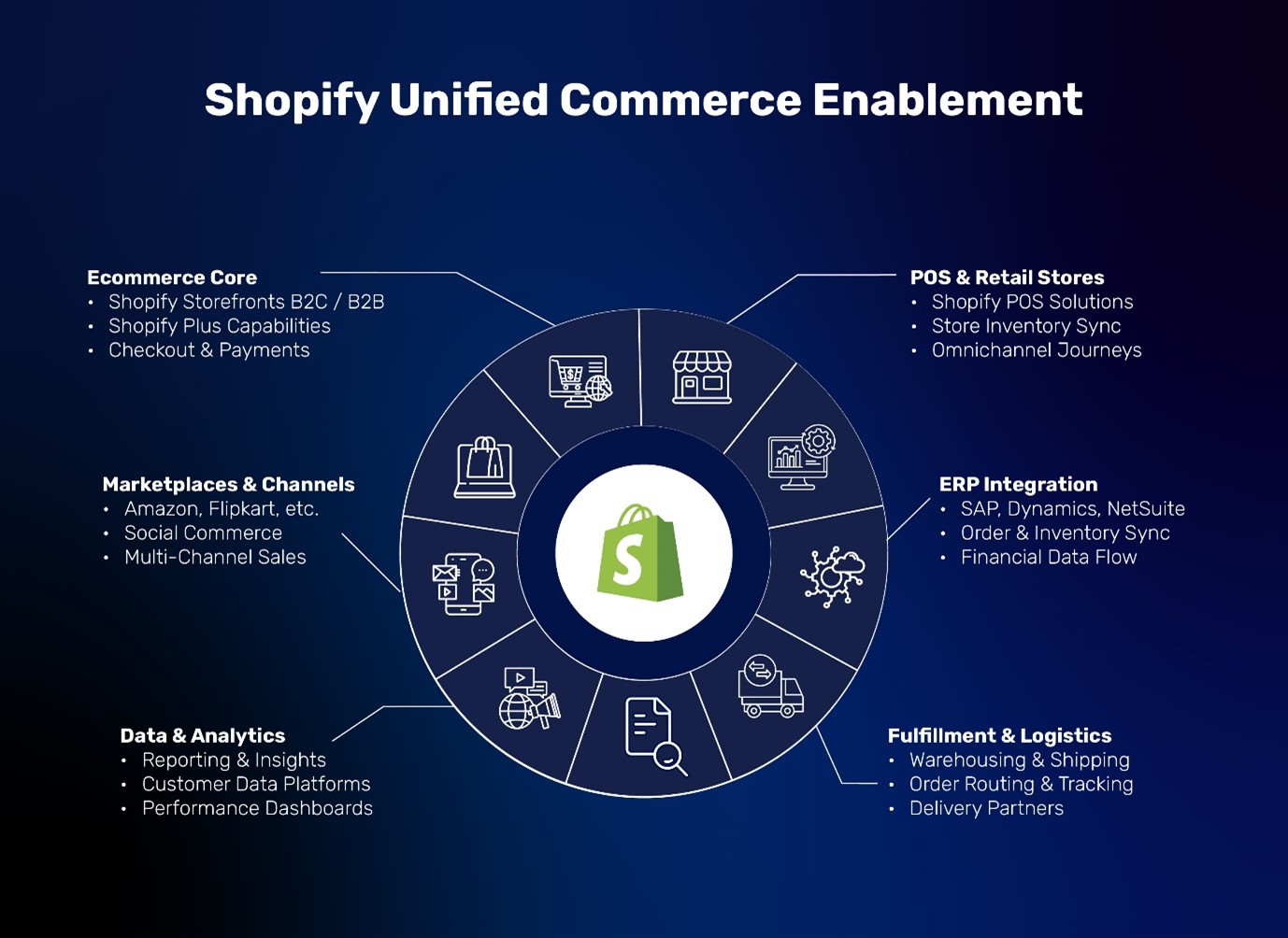
We enable Shopify Unified Commerce by connecting ecommerce, retail stores, marketplaces, fulfilment, and ERP systems into a single, consistent operating model.
Benefits of Shopify Unified Commerce Enablement
Unified inventory & order visibility
Seamless online & offline experiences
Scalable & flexible architecture
Real-time data synchronisation
Reduced operational complexity
Knowledge bytes
1
What is Shopify?
Shopify is a cloud-based e-commerce platform that allows anyone to create an online store
and sell their products. Shopify provides features such as inventory management, marketing
tools, analytics, customer service, payment processing and more. Shopify development
services empowers entrepreneurs to focus on their core competencies and grow their
businesses without worrying about the technical aspects of running an online store.
2
What are the unique benefits of Embitel’s Shopify website development services?
Our Shopify development services enable you to:
Get a complete Shopify service package that covers everything from launching to managing
your online store.
Enjoy a fully functional and user-friendly Shopify e-commerce platform that suits your
needs and preferences.
Benefit from optimized Shopify website development that leverages our team’s expertise
and experience with Shopify.
Use Shopify’s unique features like creative galleries and more to display your products
and stand out from your competitors.
Have your Shopify website designed and developed in as little as 3 weeks.
Save money on Shopify e-commerce websites as compared to other platforms.
Speed up your Shopify e-commerce mobile app development with Shopify’s development
frameworks, SDKs, and software tools.
Create modular and customizable Shopify themes with Shopify’s template files, building
blocks, and assets.
Easily build your Shopify website with Shopify’s drag-and-drop builder, the most popular
feature of the platform.
Enable Shop Pay with Shopify Payments, which helps customers to save shipping and
payment information for faster checkout.
Access comprehensive analytics reports in Shopify’s dashboards, which display an
overview of finance and product data.
Add up to 15 administrators to your Shopify admin panel, each with their own login
credentials and permissions.
Export CSV files from your Shopify admin and back up your store information easily.
3
Can I integrate third-party apps and migrate the existing ecommerce store to Shopify?
Yes, Shopify integration with third-party apps and migration of your current ecommerce store
to Shopify is possible using various appropriate apps available on the Shopify App Store.
4
What kind of analytics and reporting capabilities does Shopify provide?
The Analytics page provides important data about your sales, orders, inventory details,
store speed and online store visitors. You can easily check the performance across all your
sales channels and for any time period on a single platform.
Shopify inventory
reports displays product sales volume and ABC analysis. Shopify sales reports show product
sales, including variants. Shopify profit reports highlight product profits, accounting for
costs.
5
Does Shopify require coding?
No, Shopify does not require coding for basic setup and functionality. You can create your
store, add products, set up payment gateways, and manage orders without any coding
knowledge. However, if you want to customize your store beyond the basic features then
you’ll need to delve into coding.
6
What is Shopify one-page checkout?
One-page checkout is an ecommerce checkout process that condenses all the elements of a
standard checkout onto a single page. This includes cart contents, payment details, shipping
and billing address, and shipping options.
With a one-page checkout, users can input all relevant information, review their order, and
complete their purchase on a single page, eliminating the need for multiple page loads and
reducing the time and effort required to make a purchase.
Shopify has recently rolled out the new one-page checkout to Basic, Shopify, Advanced, and
Plus merchants. The one-page checkout is already helping merchants enhance their customers’
shopping experience and boost sales. It’s designed to be fully customizable and extensible,
allowing merchants to tailor it to their specific needs.
The defining features of a one-page checkout are simplicity and speed. By centralizing
critical aspects of the transaction process onto a single page, shoppers can input their
data, review order details, and complete transactions without navigating to different pages.
7
What is Shopify dynamic checkout?
Shopify dynamic checkout button allows customers to complete their purchase without going
through the traditional process of filling out their information on a checkout page.
Instead, it offers a streamlined experience by skipping the cart page and presenting the
buyer with their preferred payment method as the first choice. This can be extremely useful
for Shopify stores, as it enables customers to check out faster and with less friction.
These dynamic checkout buttons facilitate a tailored checkout experience based on the
buyer’s preferred form of payment. By simplifying navigation during the payment process,
they provide access to the most suitable call-to-action button for each individual customer.
8
Can I use Shopify for services?
Yes, Shopify is not just for selling physical products, it can also be used for
service-based businesses. With features like appointment booking, service listings, and
customization options, it can be tailored to meet the needs of various service providers.
This makes it a versatile platform for businesses of all types.
9
Is Shopify only for ecommerce?
Shopify is not just limited to e-commerce. While it’s primarily known for its e-commerce
platform, Shopify offers various features and templates that can be used for informational
websites as well.
10
Can I sell directly on Shopify?
Yes, you can sell directly on Shopify. When setting up your Shopify store, you can sell
directly to customers through the Shopify checkout process. This allows you to keep all the
sales revenue and eliminates the need to pay Shopify’s commission.
However, there
are a few points to keep in mind. First, you’ll need to have a verified account and a valid
credit card on file with Shopify.
11
Can I use my own domain name in Shopify?
Yes, you can use your own domain name with Shopify. If you already own a domain from a
third-party provider, you can connect it to your Shopify store.
12
What is Shopify Metafields?
Shopify metafields are custom fields that let you store extra information about your products, customers, orders, collections, and other Shopify resources beyond the default fields Shopify provides.
They are essentially data “containers” where you can keep unique details that your business needs but Shopify doesn’t include by default.
13
What are the benefits of Shopify Metafields?
Metafields in Shopify give businesses the flexibility to go beyond standard setups. They let you customise product pages with unique data, making each listing more informative and tailored to your brand. By enriching storefront content, they enable personalised shopping experiences while also boosting SEO through detailed, structured information.
Additionally, metafields empower developers to integrate third-party apps or implement advanced storefront logic, ensuring your Shopify store remains adaptable and future-ready.
14
Can Shopify handle high traffic and sales volumes during peak seasons?
Yes. Shopify is built on a cloud infrastructure that automatically scales during high-traffic events like festive sales or product launches. With Embitel’s performance optimisation and Shopify Plus capabilities, your store remains fast and secure even under heavy loads.
15
Do you offer AI-powered Shopify solutions?
Yes, we do. We integrate Shopify’s latest AI features for personalised product recommendations, automated merchandising, predictive search, and AI-driven marketing campaigns. This helps boost conversions, improve engagement, and reduce manual workload.
16
Can you customise Shopify beyond what the default theme allows?
Yes. We can build fully custom themes, modify layouts, create custom forms, and implement advanced features that go beyond the standard Shopify templates, ensuring your store feels unique and on-brand.
17
Is Shopify suitable for B2B ecommerce?
Definitely. Shopify Plus offers wholesale channels, custom pricing, bulk ordering, and advanced integrations for B2B businesses. Embitel can tailor the platform to fit your specific B2B sales workflows and client experience.
18
Can I sell internationally with Shopify?
Yes. Shopify supports multi-currency, multilingual storefronts, and regional tax/shipping settings. We help set up localised experiences so your brand connects with customers worldwide.
19
Do you handle Shopify app development?
Yes. If your business requires functionality beyond available apps, our team can build custom Shopify apps to integrate with your existing workflows, CRM, ERP, or third-party tools.
20
Can you integrate my Shopify store with ERP or inventory systems?
Absolutely. We have extensive experience integrating Shopify with ERP systems, including SAP, Microsoft Dynamics, and NetSuite, to ensure seamless synchronisation of inventory, orders, and financial data.
21
Will my Shopify store be mobile-friendly?
Yes. All our Shopify themes are responsive by design, ensuring your store delivers a smooth shopping experience on mobiles, tablets, and desktops.
22
What does a typical Shopify store development process look like?
A best-practice Shopify store development process includes discovery and solution design, wireframes & UX, custom theme builds, app/ERP/CRM integrations, QA & performance checks, SEO setup, and launch—with post-launch optimisation. Each phase has clear deliverables and milestones, ensuring the store meets brand, conversion, and scalability goals.
23
Can you migrate my existing site to Shopify without losing SEO?
Yes. A professional Shopify migration service maps products, customers, orders, URLs, and metadata; implements 301 redirects; replicates key templates; and validates structured data. Post-launch SEO checks (indexation, Core Web Vitals, schema, sitemap, robots) protect rankings and ensure a clean transition to Shopify.
24
Do you build custom Shopify themes and apps?
Yes, we do. We build custom Shopify theme development that delivers on-brand, high-performance storefronts with reusable sections/blocks.
When off-the-shelf apps don’t fit, custom app development extends Shopify with personalised workflows, headless endpoints, and secure integrations, future-proofing your Shopify services stack.
25
Is Shopify good for B2B or wholesale?
Yes. With company profiles, price lists, net terms, and quick order flows, Shopify handles B2B at scale (and Shopify Plus unlocks deeper control). Expert Shopify development services implement gated catalogs, volume pricing, approval workflows, and sales-rep tools for a seamless B2B buying experience.
26
Can Shopify integrate with ERP, CRM, PIM, or marketing tools?
Yes. Robust APIs and webhooks allow real-time sync with SAP, Microsoft Dynamics, NetSuite, Salesforce, HubSpot, PIMs, OMS/WMS, and CDPs. Mature Shopify services teams design reliable data models, error handling, and monitoring so inventory, orders, and customer data stay in lockstep.
27
What kind of post-launch support do I need?
You can plan for ongoing Shopify services such as security updates, theme/app maintenance, CRO testing, SEO/content ops, and performance monitoring. A retainers-based model (A subscription-like setup where clients pay a recurring fee for ongoing access to a company’s services and expertise) keeps your store evolving with new features, seasonal campaigns, and data-driven enhancements.
28
Can AI build a Shopify store completely?
Yes, AI can do a lot of the store setup for you, but it cannot build a full Shopify store without some human help.
With Shopify’s AI tools, you can generate a store layout, theme, product descriptions, images, and even basic SEO elements in a short time. It can take you from idea to a working storefront much faster than traditional methods.
That said, AI does not replace decision-making. You still need to define your pricing, positioning, and target audience. More importantly, complex integrations like payments, shipping rules, ERP systems, CRMs, analytics, and third-party apps must be configured correctly. If these integrations and data flows are not designed carefully, they can easily become fragmented or break as the business grows.
So, expert supervision becomes essential. A well-architected Shopify setup ensures clean data flow, stable integrations, and a backend that supports automation without disrupting day-to-day operations. Content, branding, performance optimisation, and user experience also need refinement to ensure the store not only looks good but converts and scales effectively.
Our Shopify experts support customers by helping them adopt AI, automation, and emerging eCommerce trends while ensuring their systems, integrations, and operations remain clean, stable, and future-ready.
29
How We Architect Shopify for Scale or What is Shopify scaling?
Shopify scaling means to build a store that is stable, flexible, and ready to grow without constant fixes, rework or other scalability challenges.
This includes planning for high traffic, large product catalogues, and increasing order volumes. It is not just about launching the store, but making sure it continues to perform well as the business grows.
When we architect Shopify for scale, we focus on clean theme development, fast loading pages, and a strong backend setup. We also ensure integrations like payments, inventory, and third party systems work smoothly as demand increases.
30
How to avoid SEO & Data Loss during Shopify Migration?
To avoid SEO and data loss during Shopify migration, the key is to plan and double-check everything.
Take a full backup of your current store, including products, customers, orders, and all page data. Keep your URLs the same wherever possible. If there are any URL changes, set up proper redirects so users and search engines land on the right pages.
Make sure all important SEO details like meta titles, descriptions, and image text are carried over correctly. Before going live, go through the site and check for missing data or broken pages.
Once the new store is live, monitor traffic and rankings for a while to catch any issues early.
31
When should you move to Shopify Plus?
You should consider moving to Shopify Plus when your current setup can’t keep up with your growth.
If you are handling high traffic, large order volumes, or multiple regions, Shopify Plus gives you more control and stability. It is also useful when you need advanced customisation, automation, and better integration with other systems.
Many businesses move when they want to scale faster without worrying about performance or operational limits.
32
How long does Shopify implementation take?
The time required for a Shopify implementation depends on how complex the store is.
A basic store with a standard theme and limited products can be set up in a few days to a couple of weeks. If the setup involves custom design, integrations, or data migration, it can take a few weeks to a couple of months.
Timelines also depend on how ready your data and content are. Delays usually happen when product information, images, or requirements are not finalised.
In most cases, a clear scope and proper planning help speed up the process.
33
What is Shopify POS?
Shopify POS is Shopify’s point of sale system that lets retailers sell in physical stores while staying fully connected to their online operations. It syncs inventory, orders, and customer data in real time.
It allows retailers to manage both in-store and ecommerce operations from a single system, rather than using separate tools.
Is Shopify POS included with Shopify plans?
Yes, Shopify POS comes with all Shopify plans as the basic POS Lite version. If you need advanced features like detailed reports, staff controls, or stronger omnichannel tools, you can upgrade to POS Pro as a paid add on.
What is the difference between Shopify POS and ecommerce?
Shopify ecommerce handles online sales through your website, while Shopify POS manages in-store transactions. The advantage of Shopify is that both are connected, allowing inventory, orders, and customer data to stay in sync across physical and digital channels.