

Tools and Technologies
- Communication Protocols: J1939, CAN ISO-TP, PWM, VPW, J2534
- Software Layer: Base Software (BSW) integration
- Platform: RTOS-based system (Zephyr based environment)
- Hardware: NXP microcontroller platform (MIMXRT1062)
- Architecture: Platform-independent protocol stack design
- IDE – MCUExpress
- Flashing tool – MCUXpresso Secure Provisioning Tool
- Debugger – Jlink
About the Customer
Our customer is a leading automotive tier-1 supplier, focused on developing OBD-based diagnostic tools for vehicle health monitoring, emission compliance, and data-driven vehicle improvement.
Business Challenge
The customer required a scalable and flexible diagnostic platform capable of supporting a wide range of vehicle communication protocols (J1708, J1850, ISO 9141, KWP2000, ISO 15765 and J1939).
Key challenges included:
- Integrating seamless communication between vehicle hardware, diagnostic tools, and user applications
- Enabling standardized connectivity between OBD hardware and external applications (mobile/web tools) using J2534 pass-through capability.
- Platform adaptation was a major challenge as well. The customer’s base software environment was built on Zephyr, with low-level driver support and device tree-based configuration. Embitel’s existing protocol IPs had to be adapted to this platform while preserving timing behavior and protocol reliability.
- Ensuring faster time-to-market despite protocol complexity and integration dependencies
Embitel's Solution
Our automotive engineering team delivered the diagnostic protocol capability primarily at the Base Software layer. The delivered stacks acted as reusable BSW protocol modules integrated with the customer’s platform and diagnostic application interfaces.
At a high level, the architecture can be represented as:
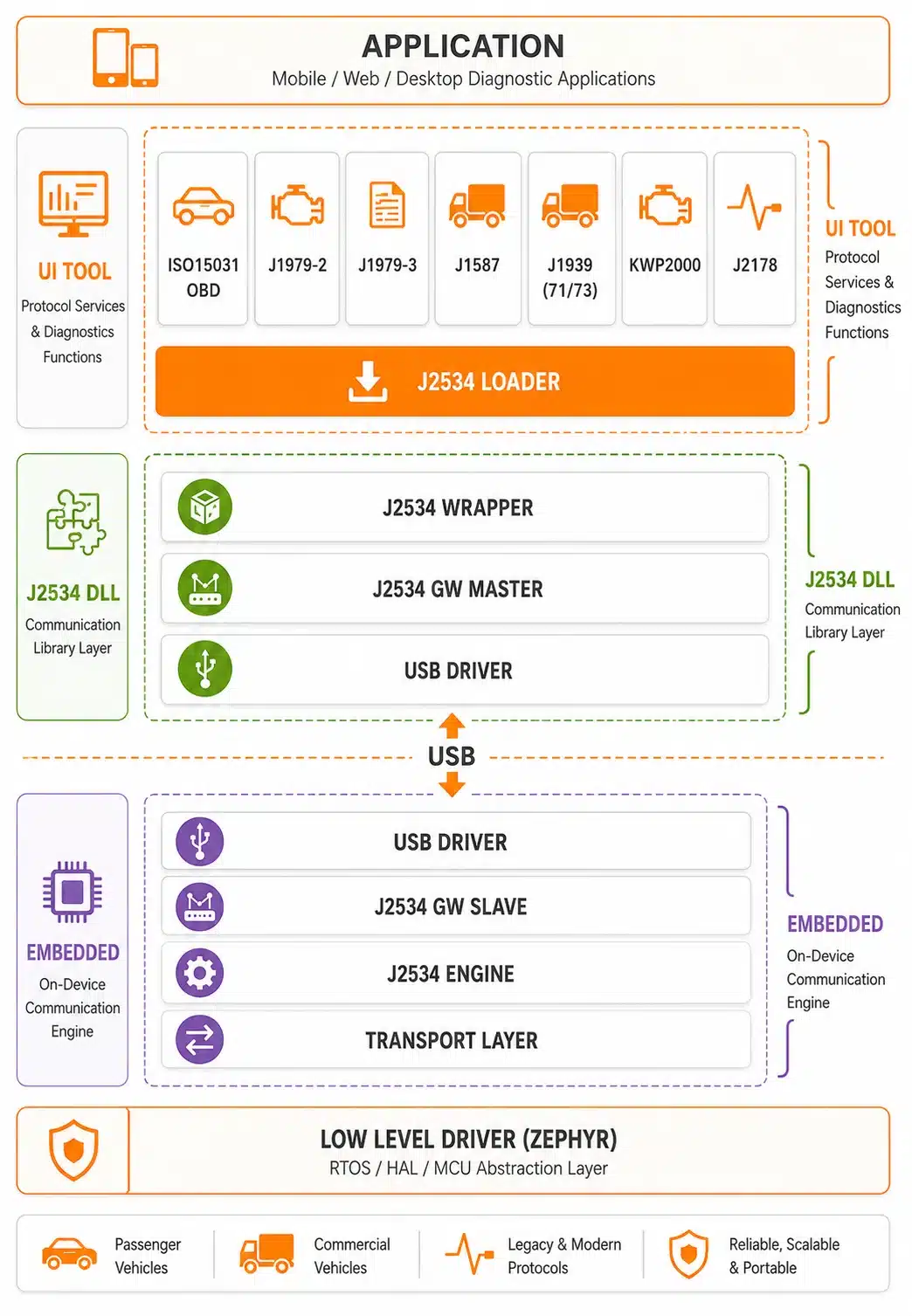
The solution included:
Development and integration of around 14 protocol IPs across multiple communication standards-
- J1939 – Supports heavy-duty vehicle communication and diagnostics over CAN networks.
- J1708 – Enables communication with legacy commercial vehicle networks used in older vehicle platforms.
- J1850 (PWM/VPW) – Supports OBD communication for legacy passenger vehicles using PWM and VPW network variants.
- J2178 – Enables standardized exchange of diagnostic information between vehicle ECUs and external diagnostic tools.
- J1587 – Facilitates diagnostic messaging and parameter exchange over J1708-based vehicle networks.
- J1979-2 – Supports advanced OBD diagnostics and access to emission-related vehicle data.
- J1979-3 – Enables retrieval of diagnostic and emissions information using standardized OBD service definitions.
- ISO 9141 – Provides diagnostic communication support for vehicles using K-Line based interfaces.
- KWP2000 – Enables ECU diagnostics, fault reporting, and service communication using the Keyword Protocol 2000 standard.
- ISO 15765 – Supports CAN-based diagnostic communication through the ISO-TP transport protocol.
- SAE J2534 – Enables pass-through communication between vehicle interfaces and external diagnostic applications.
- RP1210 – Provides a standardized API for communication between diagnostic software and vehicle communication adapters.
- ISO 15031 – Supports OBD communication requirements for vehicle diagnostics and emissions monitoring.
- APD (Auto Protocol Detection) – Automatically identifies the appropriate vehicle communication protocol without manual selection. Support for protocols such as J1939, CAN ISO-TP, PWM, VPW, and J2534 pass-through APIs.
- Integration of J2534 pass-thu capability to enable communication between OBD hardware and external applications.
- Porting and adapting protocol stacks to the customer’s RTOS-based platform (Zephyr-like environment).
- Minimal modification approach by managing scheduling and timing parameters.
- Ensuring platform-independent architecture for scalability across different hardware environments.
- Process/compliance – CMMI Level 3.
Embitel's Impact
- Accelerated development timelines by up to 50% through ready-to-deploy protocol IPs
- Enabled communication across 10+ diagnostic and vehicle networking standards through a unified software architecture
- Demonstrated platform independence with minimal adaptation effort
- Ensured on-time delivery with no major delays in project timelines
