

Software-defined vehicles (SDVs) are data-collection hubs that continuously capture telematics data, such as trip data, vehicle performance, diagnostics, driver behaviour & performance, and more. While data collection can be continuous & real-time, continuous transmission of data to the cloud server is often hampered by network disruptions.
Store-and-forward (S&F) buffers are crucial to both off-the-shelf & custom telematics control unit (TCU) solutions for SDVs to ensure data reliability and continuity. This helps fleet managers & vehicle owners obtain a complete driving history, despite intermittent connectivity.
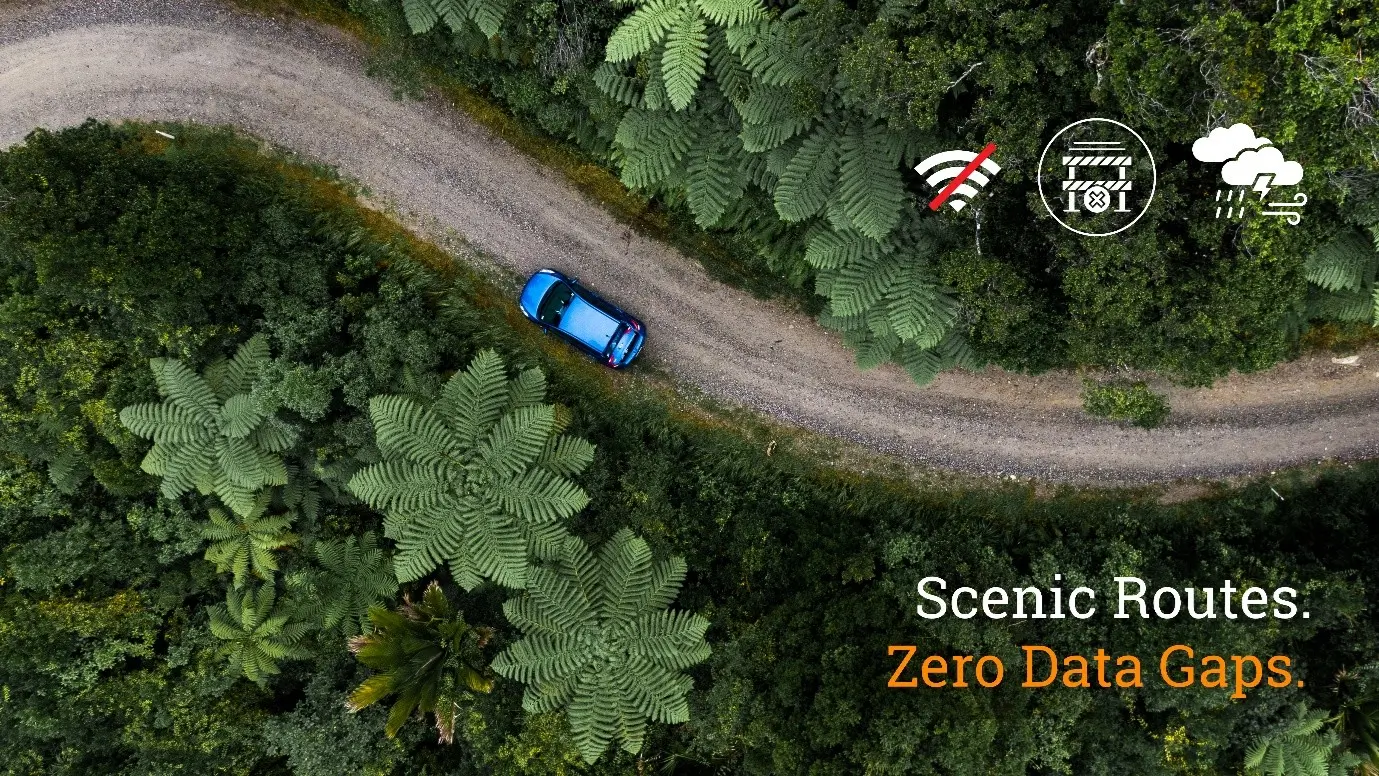
What is Store and Forward?
Store-and-Forward is a data transmission technique in which telematics data packets are stored in an intermediate node (TCU) before being forwarded to the telematics cloud server upon connecting to a reliable network.
Types of data packets handled by store and forward systems in telematics devices are:
- GPS coordinates and speed
- Vehicle diagnostic trouble codes (DTCs)
- Driver behaviour data (acceleration, braking, cornering, driver drowsiness & distraction)
- CAN Bus/Ethernet vehicle network data
- Event-based alerts (crash, airbag deployment)
- Sensor data (battery, temperature, etc.)
Core Terminologies in Store and Forward Architecture
| Terminology | Definition |
| Data Packet | The smallest unit of telematics data transmitted between the ECU and the telematics cloud server. A data packet typically includes a header (source, timestamp, sequence id & priority level), a payload (sensor/ diagnostic data), and a trailer (error-check code – CRC & checksum). |
| Packetization | TCUs generate continuous streams of data, and packetization is the process of converting this into structured & discrete data groups. |
| Non-Volatile Memory (NVM) or Persistent Storage | NVM acts as a persistent storage layer that safely holds unsent packets during network outages, ensuring no telemetry data is lost. (NAND/NOR, EEPROM, FRAM and MRAM) |
| Memory Buffer or Fast Volatile Memory (RAM) | Temporary, high-speed staging area for data packets waiting to be transmitted in the presence of a stable network connection. |
| Write | Recording data into the system’s memory cell. In TCU, it occurs when it stores a new data packet in NVM, Updates timestamps or sequence numbers, or receives feedback from the cloud server. |
| Write Endurance | Number of write and erase cycles sustained by the NVM before loss in data quality/reliability. |
| Forwarding Process | Transmitting data packets in the queue in the NVM to the cloud server once connectivity is restored. |
| Acknowledgement | Signal sent (ACK) by the telematics cloud server upon receiving the data packet. If the data packet is not received or received incorrectly, the cloud server sends a NACK signal. |
Data Transmission in Telematics Systems
In this section, we will unlock what happens to the data in software-defined vehicle TCU when it passes through regions with unreliable network.
Under Stable Network Conditions
- Data collected by the ECUs (mentioned above) is sent to the TCU through in-vehicle networks (CAN, LIN, or Ethernet). Each data point is timestamped along with information on its source.
- Data points are combined into discrete data packets to ensure the sequenced, verifiable transmission of information to the telematics server.
- Data packet enters the memory buffer or fast volatile memory and is then transmitted to the telematics cloud server over secure channels such as (MQTT, HTTPS, or TCP).
- Upon receiving the data packet, the cloud server employs data validation mechanisms and sends an ACK or NACK.
What happens when the TCUs in software-defined vehicles cannot communicate with its cloud server?
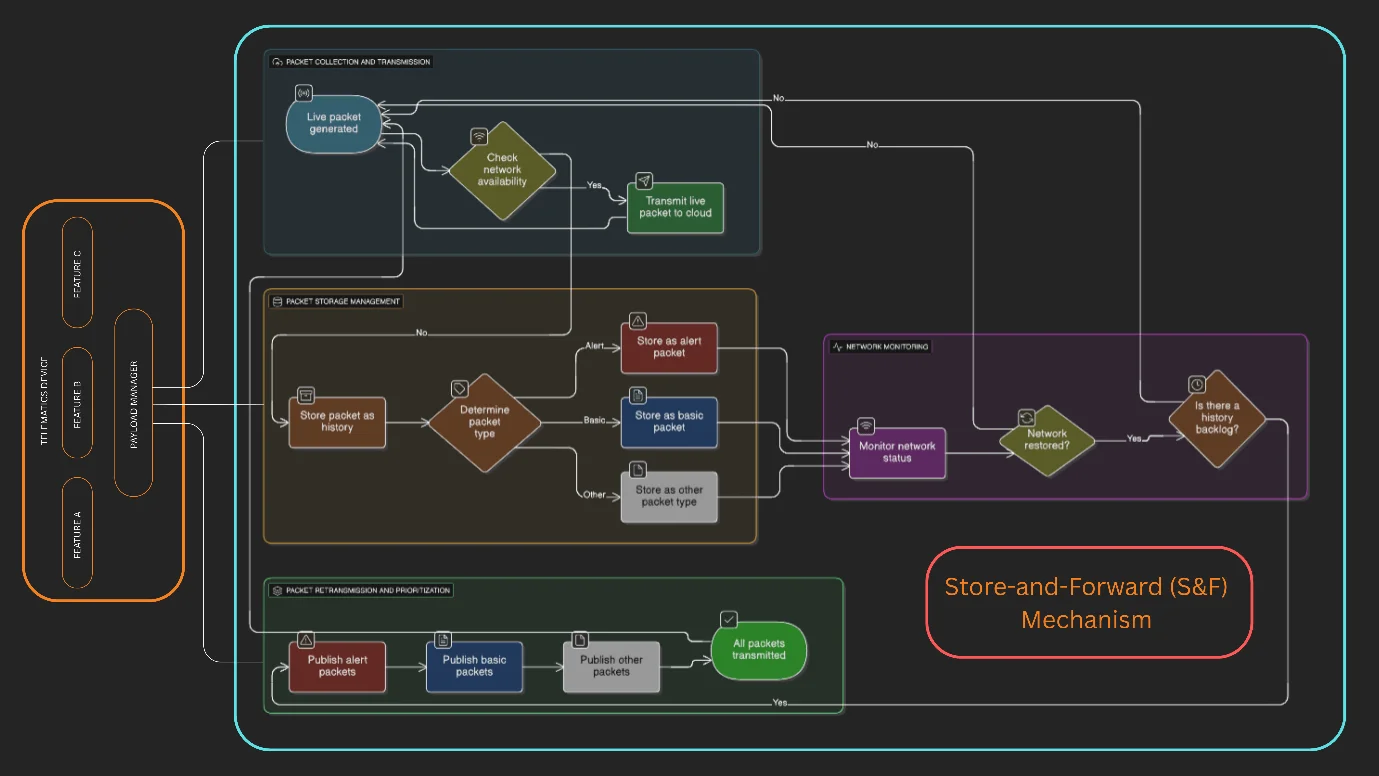
Triggering Store and Forward Mechanism
- Upon initial network disruption, telematics data remains in the volatile memory buffer (RAM), while the system retries to send the data.
- Multiple failed attempts to transmit data due to longer periods of connectivity issues trigger the store-and-forward process. This pauses data transmission attempts and activates a dedicated memory in the NVM.
- The data packet in the RAM buffer is emptied into the NVM. In this state, the data packet is retained in the NVM even when the vehicle turns off.
- When the vehicle moves to a location with a stable signal, the TCU retrieves data packets from NVM and loads them back to the RAM buffer.
- are then forwarded to the telematics cloud server sequentially.
- The server responds with an ACK or NACK based on the results of error detection mechanisms.
Error Detection Mechanisms in Store & Forward Process
Check Redundancy Cycle (CRC)
CRC acts like a digital proofreader that keeps data accurate down to the bit. Before sending a data packet, the Telematics Control Unit (TCU) runs a mathematical formula (a polynomial) on the packet’s contents to create a unique CRC code and attaches it. When the server receives the packet, it runs the same check. If the two codes match, the data is confirmed to be error-free, and an ACK is sent.
If they don’t match, a NACK tells the TCU to resend the packet from its Store-and-Forward memory.
Checksum
Telematics data packets are split into smaller fragments, and their binary values are summed and stored. Once the data is received by the server, the checksum mechanism reveals the binary sum of the transmitted data.
If the sum of the data sent is equal to the sum of the data received, an ACK signal is sent to the TCU.
Factors that Trigger the Store and Forward Process
On the go, software-defined vehicles are constantly subjected to changing environmental and infrastructural conditions that can disrupt connectivity and cause micro or macro data blackouts.
What is a data blackout?
Time period during which the TCU stops receiving vehicle performance data and transmitting it to its cloud server.
Here are some of the factors that lead to network disruptions:
- The cellular signals required for data transmission from the TCU get physically blocked or reflected due to geographical obstacles such as mountains, tunnels, tall buildings etc.
- Peak hour traffic or popular roads with increased vehicle density can lead to bandwidth congestion despite 4G/5G coverage.
- Vehicles on the move switch from one cellular tower and/or provider to another, which leads to a momentary signal loss due to network handover or network switching.
- Extreme weather (heavy rain, thunderstorms, snow etc) can degrade the signal quality received by the vehicle’s antenna.
- Technical issues such as cable routing, antenna placement, bugs in TCU firmware or software can lead to temporary freezing of data transmission.
Features of Store and Forward for Efficient Data Flow
Event Prioritization: Ensures critical information, such as safety alerts or diagnostics are transmitted to the cloud first despite limited bandwidth. When the network connection is restored, the customer can set the order in which S&F packets are sent. Usually, alert or event packets are sent first, and once those are done, the general packets are sent as history packets.
Queue Management: Prevents data congestion by maintaining the order for data transmission by respecting the chronology mentioned on the header of the data packet. Different techniques such as First-In-First-Out (FIFO), Priority FIFO, Circular Buffers, and Time-ordered queues are employed to ensure that data is preserved and ordered and delivered based on importance.
Compression and Batching: Reduces transmission time and memory wear by grouping multiple data packets together and compressing them before transmission to optimize bandwidth usage.
Fallback Transmission Paths: Maintains data flow continuity by automatically switching to alternate networks such as Wi-Fi, satellite, or delay-tolerant channels when cellular connectivity is unavailable.
Error Detection Mechanisms: Ensures bit-level data accuracy through Cyclic Redundancy Check (CRC); packets failing validation trigger a NACK and are retransmitted from the Store-and-Forward memory.
Security & Encryption: Protects sensitive telematics data using AES encryption for stored data and TLS encryption for transmitted data, ensuring authenticity and confidentiality across the communication chain.
Completing the Story Behind Every Drive
Store-and-Forward memory ensures that every second, every signal, and every event is recorded, so no part of a trip is lost, even when the network is.
At Embitel, we’ve translated this principle into practice through a ready-to-deploy, reusable Store-and-Forward memory component, built as part of our Telematics SDK.
It enables OEMs and Tier-1s to readily integrate a telematics system to track complete, traceable driving histories by capturing data through every connectivity gap.
For enquiries, contact: sales@embitel.com


