
Desktop Application Development for an Automotive Testing Solutions Provider
About the customer
Our client is a German engineering solutions provider that specializes in developing advanced electrical testing solutions. Their solutions serve the automotive, aerospace, and defense sectors to meet their stringent testing and verification demands.
From the perspective of automotive technology, their testing solutions evaluate a systems electrical disturbances, reliability and performance against relevant industry standards.
Business challenge
An automotive device under test (DUT) undergoes several complex test scenarios.
Setting test conditions such as waveform creation and execution, breakpoints, tolerances and trigger conditions are pivotal to understanding how the DUT performs.
Configuring each parameter manually, while remaining accurate, consistent and repeatable requires significant technical expertise.
Manual and hardware-based setup of test sequences can also lead to:
- Dependence on several different tools to set up one test sequence
- Risk of DUT damage due to unexpected electrical behavior
- Complex management of multiple amplifier racks
- Repeated configuration due to loss of current
- Complex handling of large datasets of testing outputs
- Slow rendering of waveform visualization
- Greater dependency on highly skilled test engineers
- Increased repetitive manual configuration
- Higher risk of configuration errors and inconsistencies
- Increased troubleshooting effort
- Difficulty reproducing benchmarked results
- Additional effort required to document and share test results
Our client approached us to digitalize the process of managing complex test cases on their testing solutions.
Embitel’s solution
Our IoT engineers developed a custom desktop application based on Qt/C++.
The app plays the role of an integrated automotive electrical testing environment that provides users with consistent workflows.
Our solution brings test configuration, waveform generation and execution, hardware control, data acquisition, DUT monitoring and protection, diagnostics, automation, analysis and reporting under one platform.
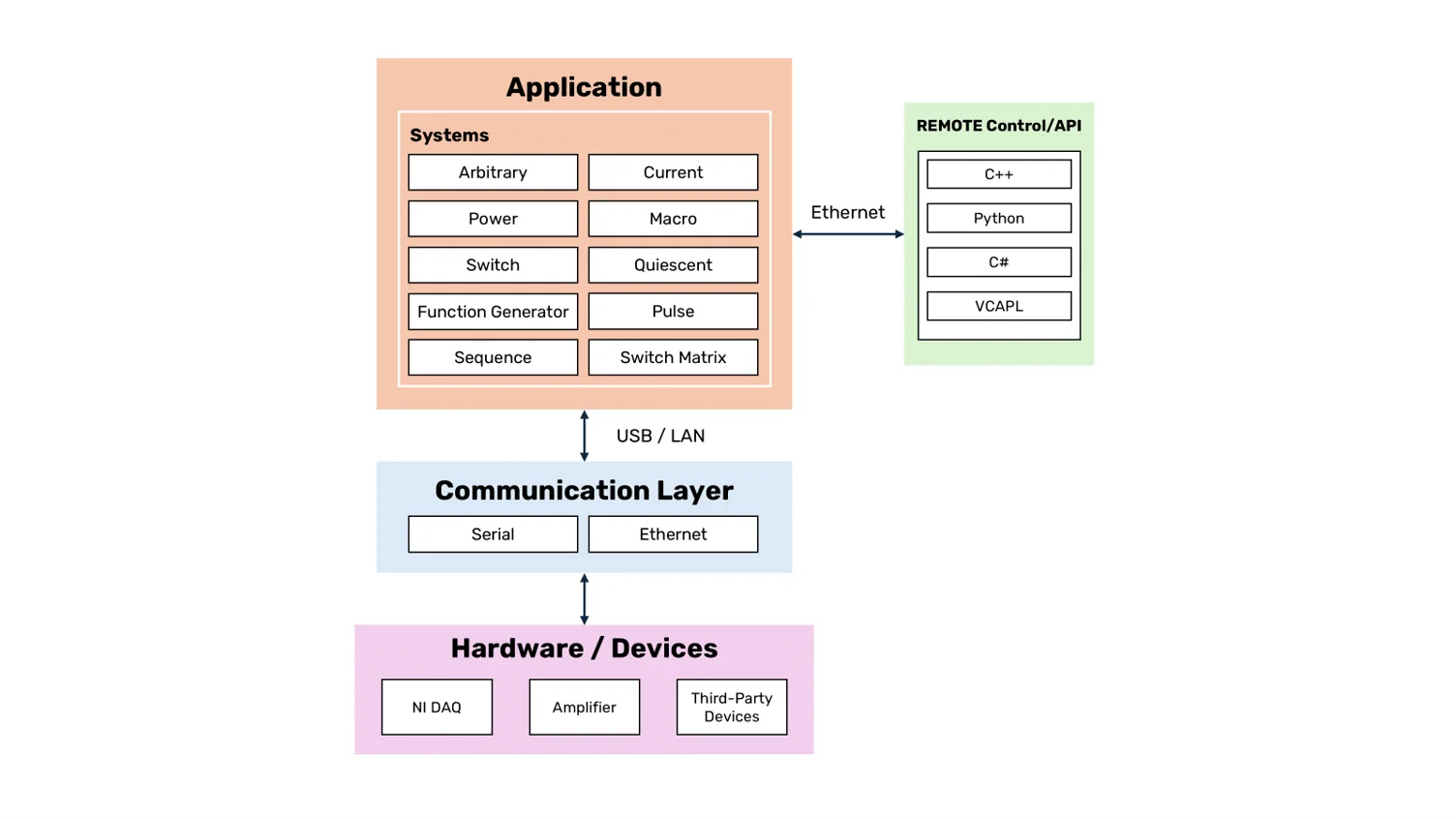
This reduces the need for test engineers to switch between different tools and work on a single app to manage complex test scenarios.
The application communicates with test hardware using multiple communication methods and command protocols, including:
- SCPI commands
- TCP/IP communication
- Serial communication
- HEX commands for low-level device interaction
Let’s breakdown how we implemented the features and created the unified testing platform.
Predicting unexpected electrical behavior in DU
We made the application capable of predictive analysis. To execute this capability, the app provides prediction algorithms based on relevant automotive standards.
These standards include ISO 16750, ISO 21498-2, MBN 11123, ISO 21780, and W80300 (EHV-09-TC1).
The app also included the client’s proprietary algorithm to help develop customized prediction scenarios.
These algorithms help users evaluate electrical behavior, flag potential electrical risks and define voltage/current limits for DUT before test execution.
High-Performance Waveform Visualization
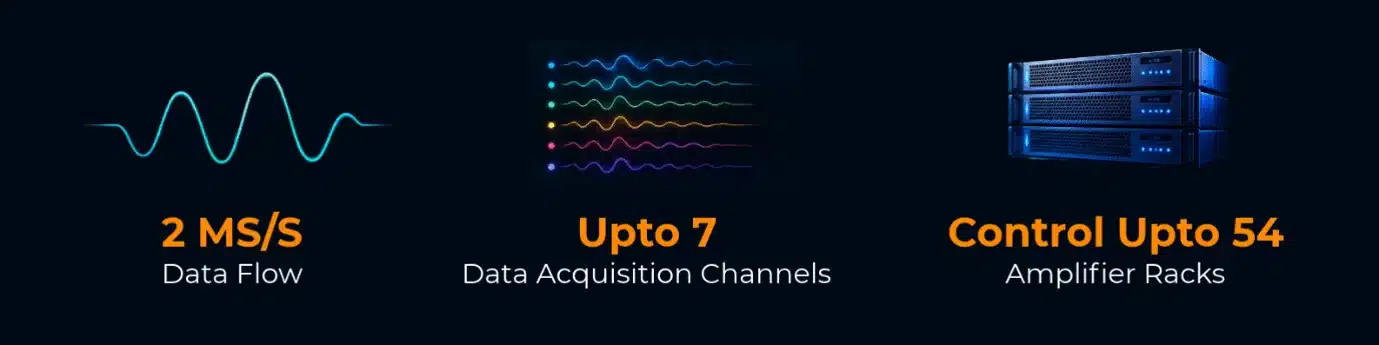
Our app handled waveform data at sampling rates of up to 2MS/s while maintaining a responsive UI.
We optimized the waveform plotting pipeline using Qt/C++ and Qwt, this resulted in preserving the original waveform’s shape and key characteristics.
This enabled smooth visualization and interactive analysis of large datasets, with cursor-based inspection for detailed signal analysis.
License-based Access Control
The app prevents unauthorized access to testing modules. The application verifies the license file uploaded by the authorized user and enables access to test functionalities.
Scaling Amplifier Capacity with Master-Slave Control
We implemented a Master-Slave architecture to allow multiple amplifier racks to operate together as a single system.
Multiple racks can be combined to increase the overall current output while maintaining centralized control of the system.
Restoring Previous Application Configuration
The application allows test engineers to save required configuration settings to an .ini file before closing.
When reopened, the saved settings were automatically loaded, allowing users to resume their previous setup without repeating the configuration process.
Multi-Vendor Hardware Support
The app supports both – client hardware and third-party amplifier devices.
It accommodates different device interfaces and communication mechanisms while maintaining a consistent test workflow for engineers.
This multi-vendor capability provides flexibility for laboratories using different amplifier and test-equipment configurations. The application eliminates the need for separate software environments for different devices.
Data Acquisition and Waveform Analysis
The application continuously acquires data from multiple channels during waveform execution.
When no waveform is running, it continues to monitor the device and displays the most recent 10 seconds of data. This reduces the need for a separate oscilloscope for basic signal monitoring.
Engineers can visualize measured waveforms, inspect values using cursors, and evaluate results against configured tolerances within the same environment.
Real-Time Diagnostics
We’ve designed the app to read the error status of connected devices every 3 seconds and displays component status in real time.
The colour codes are green for indicating normal operation and red indicating an error.
When an error occurs, an error file is generated for post-test diagnosis. A separate HEX command and response log records device communication for further troubleshooting and analysis.
This provides :
- Real-time error monitoring
- Post-test diagnostics and communication analysis
Test Automation and Sequence Execution
The app includes a built-in command sequencing system that allows users to define and execute sequences of commands automatically.
Configured sequences can be executed repeatedly with minimal manual intervention, improving test consistency and reducing repetitive engineering effort.
Code Generation
In addition to built-in command sequencing, the app provides a code-generation capability that converts actions and test steps performed through the application into corresponding executable code.
This enables users to transition from interactive test setup to automated test execution.
Remote Control
Through the app, we have enabled remote control via C++, C#, Python, and VCPAL commands. This allows external applications and test systems to control test execution.
Together, these capabilities provide multiple levels of automation such as:
- Command sequencing for automated test execution
- Code generation for creating executable test scripts
- Remote control for integration with external test systems using C++, C#, Python, and VCPAL commands
Reporting and Traceability
We developed & integrated the app with comprehensive reporting and data export capabilities for documenting and analysing test results.
Engineers can generate reports and export waveform and measurement data in standard formats, including PDF, image, CSV, TDMS, Vector, and MDF.
This enables test results to be easily reviewed, shared, analysed, and maintained for future reference and traceability.
Embitel’s impact
The application transformed a complex, hardware-dependent testing process into a unified and repeatable automotive electrical testing environment.
By bringing key testing activities into a single application, we reduced reliance on multiple tools and manual workflows.
Key outcomes include:
- Faster test setup and execution through streamlined test configuration and automated sequences.
- Improved test consistency and repeatability by enabling engineers to save, reproduce, and automate complex test scenarios.
- Reduced risk of DUT damage through configurable limits, tolerances, breakpoints, and continuous device monitoring.
- Improved testing efficiency by combining waveform generation, execution, data acquisition, visualization, and analysis in one environment.
- Faster troubleshooting through real-time error monitoring and post-test diagnostic information.
- Improved automation readiness through command sequencing, code generation, and remote-control capabilities.
- Enhanced test traceability through automated reporting and support for multiple standard export formats.
- High-performance waveform analysis with support for data rates of up to 2 MS/s while maintaining an interactive user experience.
- The app continuously acquires data from up to 7 channels during waveform execution.
- The application can control up to 54 amplifier devices within a rack.
Tools & technologies
- C++
- Qt
- Qwt
- C# / .NET DLL
- SCPI, DAQ API
- TCP/IP, Serial
- HEX commands
- BOLAB + supported third-party amplifiers
- DAQ device measurement
- Command Sequencing, Remote Commands, Code Generator
- PDF, Image export, CSV, TDMS, Vector, MDF
