

Tools and Technologies
Hardware
- NXP Microcontroller
- Infineon Gate Driver
- NXP Power Management IC
Development tools
- MATLAB
- ETAS RTA-CAR 12.8.0 NXP S32DS IDE
- CANoe
- PE Micro Debugger
- GCC and GHS Compiler
- Bitbucket
- Codebeamer
About the Customer
The customer is a global supplier of electric pump solutions for automotive applications, with a portfolio spanning braking systems, cooling pumps, actuator systems and thermal management components. As part of their electrification roadmap, they set out to develop a traction coolant pump (TCP) controller for electric vehicle thermal management systems.
3
Controller Variants
20+
Engineering Deliverables
5
Development Workstreams
3
Communication Protocols
Business Challenge
The customer needed end-to-end engineering support to develop a motor control solution for TCP applications across three hardware variants: a 12V 300W, 24V 300W, and 24V 800W controller. While they had prior experience in testing, they required support across motor control application development, AUTOSAR-based software architecture, hardware design, communication and diagnostics implementation, and functional safety-oriented development.
Embitel's Solution
Embitel supported hardware and software development across all three controller variants, covering five areas:
Motor Control Application Development
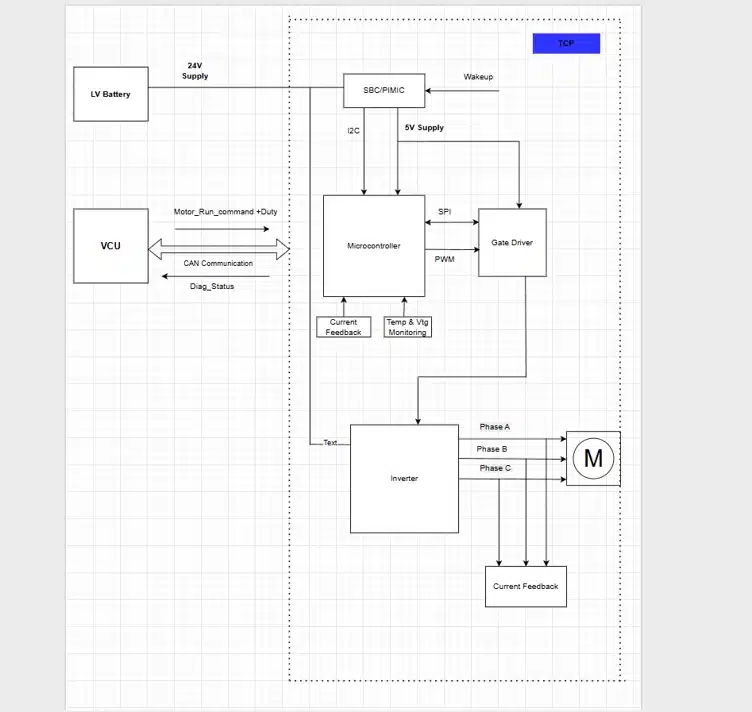
Embitel implemented a sensor less Field Oriented Control (FOC) algorithm using a MATLAB-based model development approach, supporting smoother torque control and efficient motor operation for pump applications. This included motor parameter tuning through simulation and analysis, pump-mode application development, and error handling workflows.
AUTOSAR-Based Software Development
To support scalability and modularity, Embitel implemented an AUTOSAR software architecture using the ETAS RTA-CAR stack. This covered MCAL configuration and code generation, communication stack development for UDS diagnostics, J1939, and Extended CAN 2.0B, ECU state management, bootloader workflows, and software architecture documentation.
Hardware Design and ECU Development
Embitel supported hardware architecture definition, component selection, power management and gate driver integration, and PCB schematic development for an automotive-compliant ECU. The hardware platform was built around an NXP microcontroller, Infineon gate driver, and NXP power management IC. To optimise board size, a current sensing approach was implemented for three-phase motor current measurement.
Functional Safety
Development included safety-oriented activities aligned with ISO 26262, covering functional safety requirement documentation, FMEA, hardware and software safety specifications, and system-level safety documentation.
Engineering Solutions
Embitel prepared software requirement specifications, hardware requirement specifications, hardware-software interface documentation, diagnostics and communication requirements, bootloader requirements, and functional safety documentation across the program.
Embitel's Impact
Embitel helped the customer establish structured development workflows for an automotive motor controller program from the ground up, covering areas where they had no prior capability: AUTOSAR architecture, motor control software, communication design, and functional safety. The engagement gave the customer a working controller platform across three variants, with documented software and hardware foundations for continued development.
- Provided motor controller solution across three TCP variants: 12V 300W, 24V 300W, and 24V 800W
- Implemented sensorless FOC-based motor control application using MATLAB
- Established AUTOSAR software architecture with MCAL configuration, communication stacks, and ECU state management
- Delivered UDS diagnostics and J1939 and CAN 2.0B communication implementation
- Prepared Sample-A hardware boards and engineering documentation for two controller variants
- Completed functional safety documentation aligned with ISO 26262
