Message Protection
- SecOC module developed to the AUTOSAR specification, covering transmit and receive
- Freshness value management for replay protection
- Configurable MAC truncation to match the frame layout








The implementation of Secure Onboard Communication (SecOC) has already moved from just being a good practice to a written OEM requirement. UNECE R155 makes managed cybersecurity a condition of vehicle type approval, and the ISO 21434 standard embeds it across the development lifecycle. As a result, message authentication on in-vehicle networks is now among the first controls OEMs ask for.
A CAN frame includes data and an identifier, but it does not confirm which ECU sent it. Any node on the bus, including a compromised one, can transmit a message that appears genuine. Source authentication addresses this risk by adding a cryptographic code to each critical message, which the receiver verifies before acting on it.
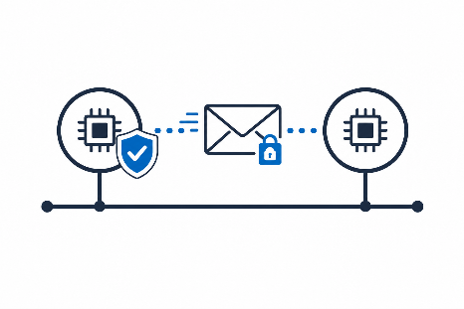
Not every attack needs to forge a message. Capturing a genuine frame and transmitting it again later can be just as disruptive, and the message itself is perfectly valid.
Freshness protection prevents this. It ensures every secured message carries a value that advances with each transmission, so a copy of an older message fails verification even though its contents were once correct.

OEM requirements do not ask you to secure the whole bus. Based on the TARA insights, they name the exact messages to protect.
Critical signals such as engine speed and vehicle speed must include authentication data within the same message frame, without changing the existing communication design

There are two ways to bring source authentication, replay protection, and coverage of designated critical signals to your ECU: develop the SecOC module in-house, or integrate a pre-tested stack.
The difference between both is primarily the work each path leaves with your team. When the SecOC is implemented from scratch, it typically takes 6 to 7 months to reach a tested module. On the contrary, when our stack is integrated, which is already tested against the AUTOSAR specification, integration on your platform is typically completed in 3 to 4 weeks.
The comparison below sets out where that difference comes from.
There are two ways to bring source authentication, replay protection, and coverage of designated critical signals to your ECU: develop the SecOC module in-house, or integrate a pre-tested stack.
The difference between both is primarily the work each path leaves with your team. When the SecOC is implemented from scratch, it typically takes 6 to 7 months to reach a tested module. On the contrary, when our stack is integrated, which is already tested against the AUTOSAR specification, integration on your platform is typically completed in 3 to 4 weeks.
The comparison below sets out where that difference comes from.
| In-house Build | With Our Pre-Tested Stack | |
|---|---|---|
| Typical timeline | 6 to 7 months to a tested module | 3 to 4 weeks of integration |
| Specification interpretation | Performed by your team | Already completed |
| Module development & testing | Built and debugged in-house | Pre-tested against the AUTOSAR specification |
| OEM variant adaptation | Engineered per programme | Handled through configuration |
| Freshness and synchronisation | Designed and stabilized in-house | Implemented within the stack |
| Team prerequisite | BSW team with SecOC experience | Standard integration capability |
| Schedule risk | Carried out by the program | Limited to configuration and integration |
Embitel's SecOC stack is a layered implementation of the AUTOSAR architecture. Each layer has a defined role, from message authentication at the top to the cryptographic hardware or software at the bottom. This separation makes the stack portable across platforms and hardware.
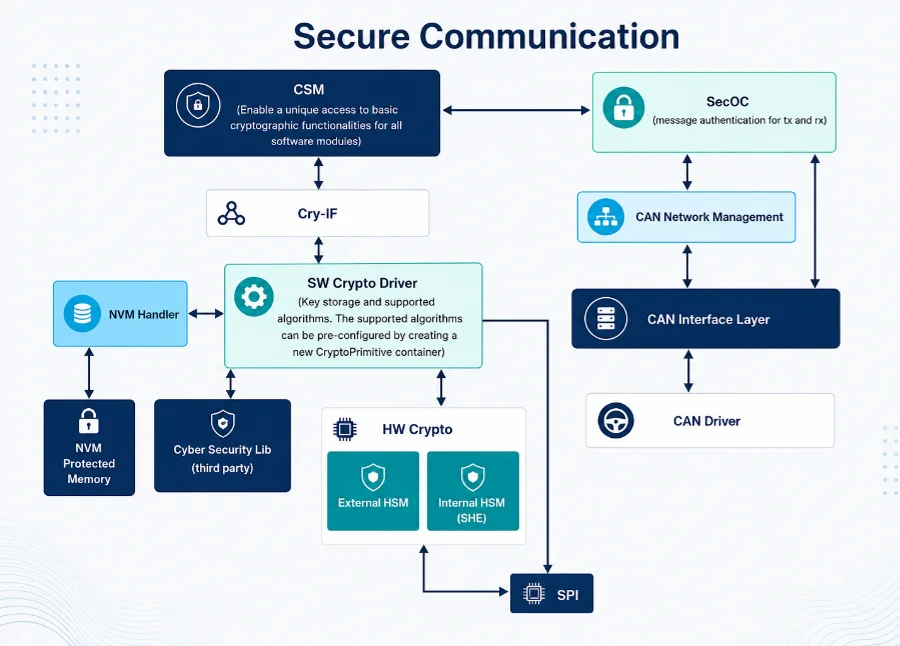
When an ECU sends a critical message, the SecOC module adds the authentication data. When a message is received, the module checks that data before anything reaches the application. Messages that fail the check are discarded.
The SecOC module does not perform the cryptography itself. Every operation is requested through the CSM and Cry-IF layers and executed by the crypto driver below. The stack supports three driver options: an internal HSM (SHE), an external HSM connected over SPI, and a software-based crypto driver for ECUs without a hardware security module.
The keys are stored in NVM protected memory, and key updates at power-on are managed by the stack. Key generation and distribution remain with the OEM's infrastructure.



Developed, tested, and documented for programs under UNECE R155 and ISO 21434.
The stack is developed under an ISO 21434 aligned process.
The code follows the SEI CERT C secure coding standard, and the module conforms to the AUTOSAR SecOC specification.
Each delivery includes fuzz test reports from internal grey-box testing and system-level penetration test reports covering black-box scenarios, executed with specialist partners. The tested behaviour is concrete: a manipulated message sent to the ECU is discarded and not processed further.
This documentation carries into your UNECE R155 assessment as inherited evidence for the communication security portion of your cybersecurity management system.
Our engagement models cover how the stack is taken up, from source code licensing to complete ownership of the implementation.
IP Licensing, microcontroller-based The stack is licensed for a single microcontroller variant, for example NXP S32K144, and the license applies to the specified variant only.
Usage rights on the licensed variant cover unlimited production units, multiple OEM programs, and multiple customer projects. Standardized support services are available after delivery.

Embitel integrates the stack into your environment, configures it to your OEM's SecOC variant, and carries out testing and validation on your ECU.
Where the OEM's requirement departs from the standard module, the verification backend is reused, and the custom use case is engineered on top of it.
SecOC (Secure Onboard Communication) is the AUTOSAR module that adds authenticity and integrity to in-vehicle communication. It attaches a message authentication code (MAC) and a freshness value to designated messages, forming the Secured I-PDU defined by the specification, so a receiver can verify who sent a message and that it is not a replay.
SecOC authenticates messages but it does not encrypt them. The message content remains readable on the bus, but its origin and integrity are verified. Where a program also requires confidentiality, encryption is addressed within the wider crypto stack based on the program's requirements.
Yes. The Embitel SecOC stack follows the AUTOSAR SecOC specification and can also be customised for non-AUTOSAR and proprietary environments, so the same specification-conformant protection is available regardless of the platform architecture.
Each secured message includes a freshness value, typically a counter that increases with every transmission. The receiver verifies the MAC against both the payload and the freshness value, so a replayed message fails verification even if its content was previously valid.
No. An HSM is recommended but not required. The stack supports internal HSMs such as SHE, external HSMs connected over SPI, and software-based crypto drivers for ECUs without a hardware security module, which is common on legacy platforms.
The stack supports CAN, CAN FD, and Ethernet in line with the AUTOSAR specification. It has also been validated in projects using CAN and CAN FD.
Neither standard name SecOC as mandatory. Both require managed cybersecurity, and message authentication is the control that threat analyses regularly converge on for spoofing and replay risks. SecOC is the AUTOSAR-defined mechanism that satisfies that requirement.
The stack is available as licensable IP with complete source code or as a full-service engagement where Embitel manages integration, configuration, and testing. Platform integration typically takes 3 to 4 weeks. Custom implementations beyond the standard module take 10 to 12 weeks, provided the requirements are stable and defined.