


One evening, dark clouds gather, and the road shines with rain. Out of nowhere, someone steps onto the crossing. Your car reacts instantly, slowing down and steering safely past. You are relieved.
Behind that instant decision lies a network of Artificial Intelligence (AI) and Machine Learning (ML) models, constantly learning from every mile driven. Together, they are rewriting what automotive safety means.
AI and Machine Learning in ADAS (Assisted Driver Assistance Systems) represent an evolution today. They are not merely warning systems, but intelligent partners in driving, focusing on enhanced safety, efficiency and an intuitive user experience, all thanks to real-time data processing and adaptive capabilities. Unlike older systems built on rigid, rule-based logic, AI/ML in ADAS continuously learn from vast datasets, becoming more accurate and adaptable over time.
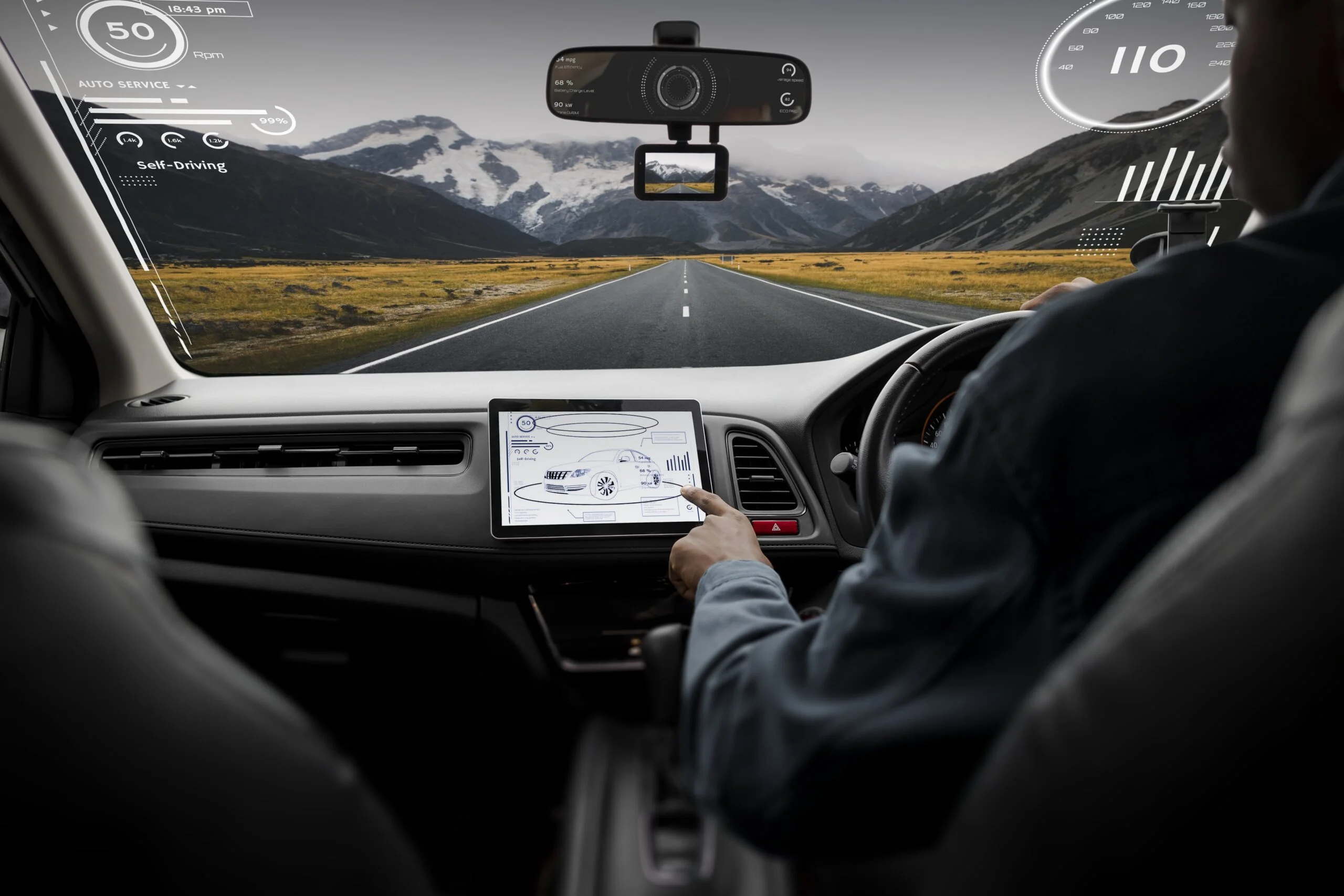
In this blog, we explain how Machine Learning and AI in ADAS are powering next-generation automotive systems and why this matters for your journey and safety.
The Shift from Static Rules to Adaptive Intelligence with AI in ADAS
You may have used traditional ADAS features, such as automatic emergency braking, lane departure warning, or blind-spot monitoring. These systems work based on fixed, pre-defined rules.
For example, if the vehicle radar detects a car within a certain distance, braking is initiated. If the camera sees your vehicle drifting out of lane without an indicator, an alert is sent. These rule-based systems were impressive in their time, but they are limited in flexibility and context.
AI and ML in ADAS have turned reactive systems into predictive ones. Instead of just detecting a pedestrian, your car analyses motion, surroundings, and probability and acts accordingly to avoid risk.
According to a recent article in The Financial Express, Machine Learning enables ADAS to analyse complex inputs like traffic density, weather, and driver behaviour, to make fast, context-aware decisions.
In other words, AI in ADAS transforms the system from “If event A then action B” into “Given context C and data D, decide best response E”. That shift is transforming the way Advanced Driver Assistance Systems (ADAS) solutions work.
Five Key Areas Where AI & GenAI Drive Next-Gen ADAS
- Synthetic Data Generation for Training and Testing
- Simulation and Scenario Generation
- Enhanced Perception through Data Augmentation
- Fuse sensor outputs (camera + radar + lidar) for richer understanding.
- Augment data to handle adverse weather, urban clutter, and poor lighting.
- Anomaly Detection and Predictive Maintenance
- Human–Machine Interaction and Personalisation
Collecting real-world driving data under every scenario, whether it involves heavy rain, snow, urban cyclists, or construction zones, is costly, time-consuming, and sometimes dangerous.
AI in ADAS helps generate synthetic data: virtual environments populated with simulated vehicles, pedestrians and conditions. This helps train ML models more broadly and accelerates development.
Use-case: A simulation creates hundreds of rare scenarios, say for example, a child dashing between parked cars at night. These scenarios are used in training ADAS perception. This means your system is prepared for the “unexpected”.
Closely related to the first, this focuses on running and validating next-generation ADAS across various scenarios before deployment. Imagine your car has already “practised” driving through a foggy highway, long before you ever face it in real life. It is better to be prepared, right?
Perception is a key pillar of ADAS: Cameras, radar and lidar feed raw data, but without sophisticated algorithms, it remains raw.
In ADAS systems, AI/ML algorithms can –
Example: Deep models trained to recognise cyclists in twilight or fog. The results are better detection, fewer false alerts and safer decisions.
AI in ADAS does more than just help you while driving. It also keeps the system healthy and ready. Predictive maintenance uses ML to monitor ADAS component health, detect anomalies and schedule maintenance before failure.
A study highlights AI and Machine Learning in predictive-maintenance modelling improve reliability. So, your ADAS is not just smart, it stays smart and safe.
The system is following you, adapting to you. AI models can learn driver behaviour, road conditions, preferences and personalise the experience.
For instance, if you tend to favour gentle braking and urban driving, the system can adjust alert thresholds. In India’s complex traffic environment, ML-enabled ADAS features like pedestrian & cyclist detection are especially important.
How Does AI in ADAS Work?
Let us check behind-the-scenes of AI-powered ADAS:
Sensor Fusion & Data Flow
Multiple sensors (cameras, radar, lidar, ultrasonics) provide different “views” of the environment. A camera sees visual imagery, radar measures speed and distance, lidar forms 3D maps, and ultrasonics detect short-range obstacles.
AI and Machine Learning in ADAS integrates these: combining data streams, filtering noise and forming a cohesive situational model. For example, a neural network might weigh radar reliability higher in foggy conditions, camera reliability higher in daylight.
Perception and Prediction
Once all the sensor data is combined, the ML models can spot and identify things around the car like other vehicles, people, lane lines, and traffic signs. They can also predict what might happen next. For example: “This pedestrian may step onto the road in about 2.5 seconds based on how they’re moving.”
Research shows that AI/ML based ADAS systems can reach very high accuracy, with some models getting F1 scores above 80% for predicting driving manoeuvres.
Decision-Making and Control
The next step is decided by the system. Should we brake? Steer? Alert? This is done based on the advanced algorithms and sometimes through reinforcement learning or neural networks, which have been trained on many driving scenarios.
Continuous Learning and Edge AI
A vital feature is that the model does not remain static. With firmware over-the-air (OTA) updates and cloud-based data aggregation, the system learns from millions of kilometres of driving data. Edge computing ensures decisions are made in milliseconds on the vehicle itself. The models evolve, adapt to new conditions and new markets.
Generative AI (GenAI) in ADAS
Generative AI is now becoming a part of ADAS. Technologies like GANs (Generative Adversarial Network), diffusion models, and even large language models are starting to appear in automotive systems. But how do they actually fit in?
- GANs generate diverse training data like weather, lighting and road conditions
- Diffusion models simulate rare, complex event sequences, scenario simulation
- LLMs enable natural-language interfaces through voice and text
Real-World Use Cases of AI in ADAS That Matter
- Urban Collision Avoidance
- Highway Fatigue and Lane Drift
- Mixed Traffic and Pedestrian Safety
- Fleet & Predictive Maintenance
For commercial vehicle operators, AI-powered ADAS not only alerts during driving but monitors system health, predicts component failures, and reduces downtime by as much as 30% says a report.
In dense city traffic, sudden braking by other vehicles is common. AI/ML based ADAS systems can detect erratic motion early (via sensor fusion + predictive models) and intervene. Research shows ML algorithms reduce false alerts by up to 60% and boost true detections by approx. 35%.
On long drives, your attention may wander. AI-based ADAS monitors steering behaviour, lane position, driver inputs and issues gentle corrections. Because ML learns patterns of fatigue and drift, it can intervene more accurately than older systems.
In Indian markets with unpredictable traffic and varied vehicles (motorcycles, rickshaws, pedestrians, automotive systems are trained on local data to help detect pedestrians, cyclists, and small vehicles more reliably.
One study suggests ADAS adoption could reduce accidents by up to 40% in complex traffic environments.
What This Means For You
When you get behind the wheel or manage a fleet, you are not just buying sensors or features. You are actually choosing a system that learns, adapts and improves. AI and Machine Learning in ADAS move beyond reactive assistance to proactive protection.
According to Number Analytics, they help reduce human error, which accounts for nearly 94% of serious crashes, by compensating for our cognitive limitations.
How Embitel Adds Value to AI in ADAS Development
At the heart of every intelligent mobility innovation lies one essential ingredient: engineering expertise that bridges imagination and implementation. Embitel Technologies is the perfect description for this.
For around two decades, Embitel has helped global automotive OEMs and Tier-1 suppliers design, develop, and deploy complex automotive solutions that make vehicles smarter, safer, and more responsive. Our end-to-end automotive technology expertise ensures that every layer from sensors to software to the cloud works in perfect synchrony.
- Deep Domain Expertise in Embedded & Automotive Software
- Adaptive Cruise Control (ACC)
- Lane Keeping Assist (LKA)
- Autonomous Emergency Braking (AEB)
- Traffic Sign Recognition (TSR)
- Driver Monitoring Systems (DMS)
- AI/ML-Driven Perception & Sensor Fusion
- Sensor fusion algorithms that merge radar, lidar, and camera data for 360° situational awareness
- Deep learning models for object detection, tracking, and behaviour prediction
- Synthetic data generation and simulation frameworks that speed up model training and validation
- Scalable Architecture for Software-Defined Vehicles (SDVs)
- Centralised perception and decision-making
- Over-the-air (OTA) updates for continuous learning and improvement
- Integration with cloud analytics and digital twins for lifecycle optimisation
- Validation, Simulation & Test Automation
- Functional Safety & Compliance
- Global Delivery, Local Insight
- Flexible engagement models (project-based or dedicated offshore teams)
- Rapid prototyping support
- End-to-end lifecycle services from concept to production
Embitel’s engineers specialise in embedded systems, AUTOSAR, functional safety (ISO 26262) and model-based design. This foundation allows us to develop and integrate ADAS features such as:
Each solution is designed to meet strict automotive quality standards ensuring real-time responsiveness, reliability, and compliance.
We bring AI/ML expertise into ADAS perception pipelines, enabling systems that “see” and “understand” complex driving environments. Our teams work on:
This means our partners can deliver ADAS products that perform accurately in diverse global driving conditions from European highways to Indian city traffic.
The future of ADAS lies in centralised computing and domain controllers. Embitel helps businesses migrate from distributed ECUs to high-performance compute platforms. Our SDV-ready solutions support:
This ensures that our customers’ vehicles are not just compliant today, but future-ready for Level-3 and Level-4 automation.
With hardware-in-loop (HIL), software-in-loop (SIL), and model-in-loop (MIL) setups, Embitel offers comprehensive testing ecosystems for ADAS validation. We also deploy AI-driven simulation and scenario-generation frameworks that prepare systems for rare edge cases before deployment, reducing field-testing time and improving safety outcomes. This gives you faster time-to-market and a system with high reliability.
We ensure all ADAS solutions meet global safety and quality standards, including:
Through these frameworks, we ensure our customer’s products are intelligent, safe, secure, and globally certifiable.
Embitel combines global automotive partnerships with a deep regional understanding of markets such as India, Europe, and North America. Our engineers co-create solutions with OEMs and Tier-1s, offering:
This helps customers reduce costs, shorten development cycles, and accelerate their innovation roadmap.
Conclusion
The role of AI in ADAS is nothing short of transformative. From synthetic data and simulation to perception, decision-making, continuous learning, and driver personalisation, these systems are rewriting the rules of road safety.
For OEMs, Tier-1s and mobility stakeholders, the message is clear: integrating AI/ML is not an option but a differentiator.
For drivers and fleet managers, the message is to choose vehicles whose ADAS is not just “assistive” but “adaptive”.