
Modern automotive electronic control units (ECUs) periodically receive software updates to improve functionality, introduce new features and rectify bugs.
While Over-the-Air (OTA) updates are becoming increasingly common, many production and service environments still rely on diagnostic programming using Unified Diagnostic Services (UDS).
Regardless of the update mechanism, ensuring that only authentic, untampered software is installed on an ECU is a fundamental automotive cybersecurity requirement.
Historically, ECU flashing relied on mechanisms such as cyclic redundancy check (CRC) to verify that data transferred during programming was not corrupted. Although CRC is effective for detecting accidental transmission errors, it does not provide protection against intentional software manipulation.
A malicious actor could modify firmware, generate a new CRC value, and still successfully program the ECU. For connected automotive systems, this limitation poses a significant security risk.
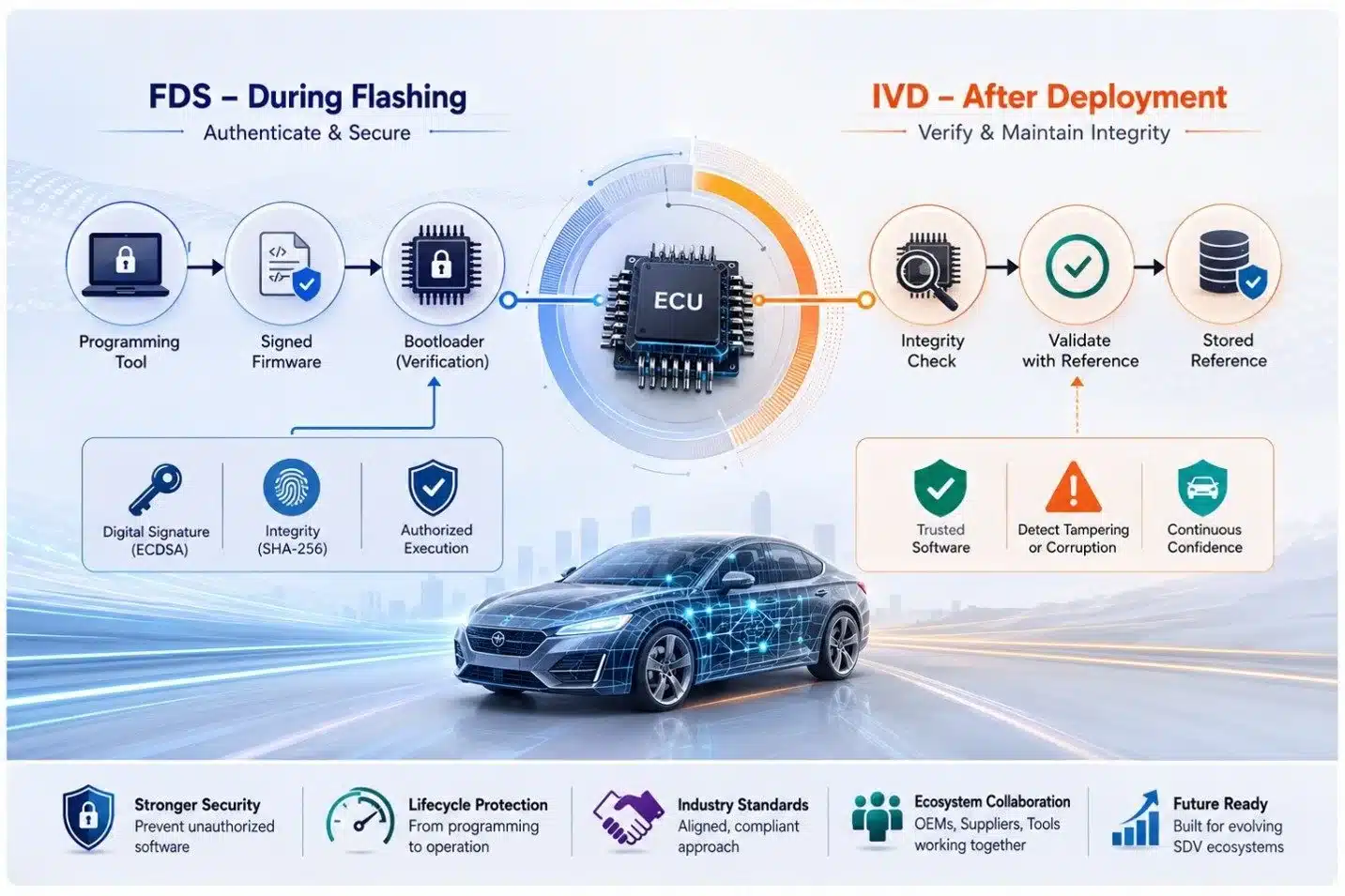
To address these challenges, automotive manufacturers are adopting Flash Data Security (FDS) and Integrity Validation Data (IVD). While both mechanisms protect ECU software, they serve different purposes within the software lifecycle.
Together, they establish a layered security approach that ensures software authenticity and software integrity throughout vehicle operation.
Why Traditional ECU Flashing Is No Longer Enough
The conventional ECU programming process consists of three primary phases: pre-programming, programming execution, and post-programming verification. During programming, diagnostic services transfer software to the ECU, which stores it in flash memory before initiating execution.
For many years, CRC-based verification was sufficient because the primary concern was detecting communication errors caused by electrical noise or interrupted data transfer. However, today’s threat landscape has evolved.
Modern attackers can potentially gain access to diagnostic interfaces, compromise programming tools, or manipulate firmware before installation. In such scenarios, CRC verification alone cannot distinguish between genuine OEM software and a modified firmware image.
As long as the modified software produces a valid CRC, the ECU may accept and execute it. Software integrity fails at this point and vehicles get compromised.
This creates opportunities for various breaches such as unauthorized feature activation, malicious code injection, safety function bypass, and intellectual property theft.
The automotive industry therefore requires mechanisms that not only verify data integrity but also software authenticity.
Flash data security (FDS) does exactly that. It ensures authenticity of data.
Let’s first understand the basics of FDS and then take it forward.
Understanding Flash Data Security (FDS)
Flash Data Security is a secure programming mechanism that authenticates firmware before allowing it to execute on the ECU. Unlike CRC, which simply verifies whether data has changed during transmission, FDS ensures that the software originates from an authorized source and has not been altered.
The principle is straightforward. Before firmware is released, it is digitally signed using the OEM’s private cryptographic key. During the flashing process, the ECU verifies this signature using the corresponding public key securely stored within the device. If the verification succeeds, the firmware is considered authentic. If verification fails, the ECU rejects the software and prevents execution.
A typical FDS-enabled programming sequence includes:
- Diagnostic security access authentication.
- Firmware download using standard UDS programming services.
- Storage of the application image in flash memory.
- Transfer of digital signature information.
- Signature verification inside the ECU.
- Controlled application startup only after successful authentication.
Because the ECU never stores the private signing key, attackers cannot generate valid signatures even if they gain access to the programming interface. This asymmetric cryptographic model establishes a strong chain of trust between the software development environment and the production ECU.
Cryptographic Building Blocks Behind FDS
Flash Data Security combines multiple cryptographic techniques, each serving a specific purpose within the secure programming process.
SHA-256 for Integrity Verification
Secure Hash Algorithm 256 (SHA-256) generates a unique mathematical fingerprint for the firmware image. Even a one-bit modification results in a completely different hash value, making unauthorized changes immediately detectable.
Rather than comparing the entire firmware directly, both the signing tool and the ECU independently calculate the SHA-256 digest. Matching hash values confirm that the software content remains unchanged.
ECDSA for Firmware Authentication
Integrity alone is insufficient because an attacker could generate a new hash after modifying the firmware. To establish authenticity, FDS uses the Elliptic Curve Digital Signature Algorithm (ECDSA).
The firmware hash is digitally signed using the OEM’s private key. The ECU stores only the corresponding public key and uses it to verify the received signature.
If the signature validation succeeds, the ECU can confidently determine that the software was produced by an authorized entity and has not been altered after signing.
Compared with traditional RSA implementations, ECDSA offers equivalent security with significantly smaller key sizes, making it well suited for resource-constrained automotive ECUs.
Secure Key Management
The effectiveness of Flash Data Security depends heavily on protecting cryptographic keys.
Private signing keys remain under strict OEM control and are typically used only within secure production or release environments. These keys are never distributed to software suppliers or embedded within the ECU.
The ECU stores only the public verification key, usually inside protected flash regions or One-Time Programmable (OTP) memory. OTP memory cannot be erased or overwritten after programming, preventing unauthorized replacement of the trusted verification key.
Development environments generally use separate development keys for integration, debugging, and testing. Production vehicles, however, are programmed using OEM-controlled production keys, ensuring that only officially released software can be installed in the field.
This separation simplifies development while maintaining production security.
While FDS solves the problem of secure flashing, software integrity after deployment still needs validation. For that, we have Integrity Validation Data. Now, let’s take a deep dive into that.
What Is Integrity Validation Data (IVD)?
Integrity Validation Data (IVD) is a security mechanism that verifies the integrity of software stored in an ECU after deployment, ensuring it remains unaltered throughout its operational lifecycle.
IVD continuously validates software integrity after installation. Instead of focusing on the flashing event, it verifies that the software currently stored in ECU memory still matches the expected reference values.
An ECU may perform integrity validation:
- During diagnostic sessions.
- At system startup.
- As part of periodic self-tests.
- Before executing safety-critical functions.
The process typically involves recalculating the firmware hash using SHA-256 and comparing it against the stored reference value. Any mismatch indicates potential corruption or unauthorized modification.
Unlike FDS, IVD does not authenticate the software source. Instead, it confirms that the installed software remains exactly as intended throughout the ECU’s operational life.
FDS and IVD: Complementary Security Mechanisms
Although Flash Data Security and Integrity Validation Data both rely on cryptographic hashing, they address different security objectives.
FDS validates software during programming by verifying both authenticity and integrity before execution. It prevents unauthorized firmware from being installed in the first place.
IVD validates software after deployment by confirming that the memory contents remain unchanged during normal operation. It helps detect corruption caused by hardware faults, unexpected memory degradation, or unauthorized modifications that occur after programming.
Together, these mechanisms provide end-to-end protection across the software lifecycle. FDS establishes trust at installation, while IVD preserves trust throughout operation.
Optimizing Secure Flashing Performance
One concern frequently associated with cryptographic verification is increased programming time.
Hashing an entire firmware image after programming can introduce noticeable delays, particularly as ECU software sizes continue to grow.
A practical optimization is incremental hash computation.
Instead of waiting until all programming is complete, the ECU calculates the SHA-256 hash block by block as firmware data is received. Once programming finishes, only the final hash comparison remains, significantly reducing overall verification time.
For larger applications, additional optimizations such as firmware compression using algorithms like LZSS can further decrease data transfer time. Although compression is not required for every project, it provides an effective option when flashing performance becomes a critical requirement.
Similarly, firmware encryption using AES can protect software while it travels across the communication bus, adding another security layer beyond digital signatures.
Looking Ahead: Hardware Security Modules
As automotive cybersecurity requirements continue to evolve, many next-generation microcontrollers integrate dedicated Hardware Security Modules (HSMs).
An HSM accelerates cryptographic operations such as SHA hashing, digital signature verification, encryption, and secure key management. By offloading these computationally intensive tasks from the main processor, HSMs improve both security and programming performance.
In addition to hardware acceleration, HSMs provide isolated execution environments where cryptographic keys remain inaccessible to application software, significantly reducing the attack surface.
As software-defined vehicles become more common, HSM-enabled secure boot, secure diagnostics, and secure OTA updates are expected to become standard features across automotive platforms.
Supporting Compliance with Automotive Cybersecurity Standards
Cybersecurity is no longer an optional feature for modern vehicle development. Standards such as ISO/SAE 21434 and the United Nations Regulation No. 155 (UN R155) require manufacturers to identify cybersecurity risks and implement appropriate protection mechanisms throughout the vehicle lifecycle.
Flash Data Security and Integrity Validation Data directly support these objectives by helping manufacturers:
- Prevent unauthorized software installation.
- Protect software authenticity.
- Detect firmware tampering.
- Preserve software integrity after deployment.
- Strengthen secure diagnostic and programming workflows.
When integrated with secure boot, secure diagnostics, cryptographic key management, and hardware-based security, these technologies contribute to a robust defense architecture that aligns with industry best practices.
Conclusion
Automotive cybersecurity is a vast discipline, and focused mechanisms such as FDS and IVD can play a critical role in protecting vehicle software. The real challenge lies in integrating these measures into a unified security architecture. Standardized processes and close collaboration among OEMs, suppliers, semiconductor vendors, and tool providers can simplify implementation and strengthen cybersecurity across the vehicle lifecycle.