

For a long time, Shopify meant building your store around the platform’s own storefront. Today, that is no longer the only way to use Shopify.
The rise of APIs, composable architectures and modern frontend frameworks has changed what businesses can build around an ecommerce platform. Shopify now supports everything from traditional storefronts to fully custom headless experiences, with its Storefront API sitting at the centre of that shift.
For enterprise brands, that opens up some interesting possibilities, but also some important questions.
Is headless really necessary? What do you gain by separating the storefront from Shopify? And when does that extra flexibility justify the additional development and maintenance?
This guide looks at Shopify headless commerce from a practical enterprise perspective, covering the architecture, Hydrogen, Storefront API, SEO, integrations, costs, migration and when going headless actually makes sense.
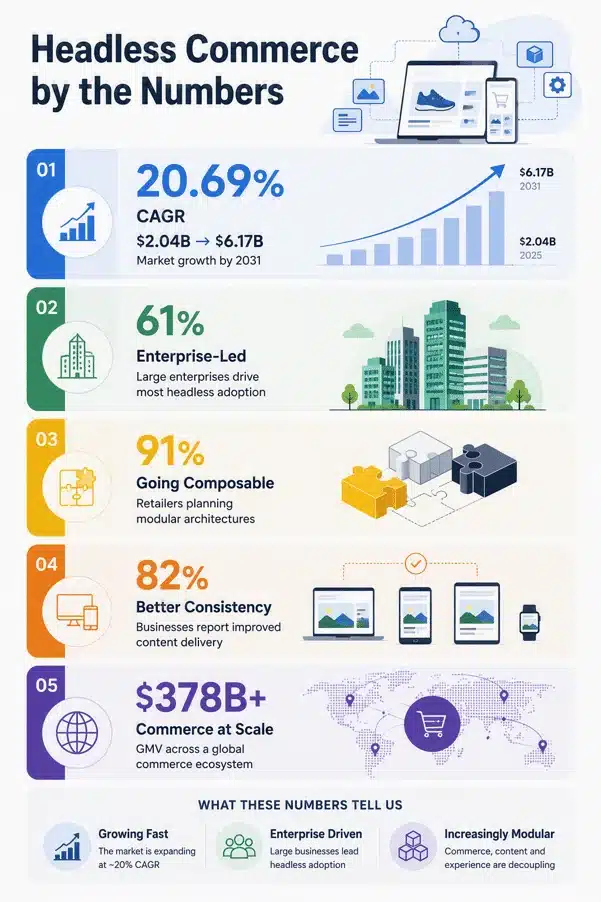
Headless commerce is moving beyond an early-adopter technology. Recent market research and enterprise surveys show growing interest in composable and API-driven ecommerce architectures.
What is Shopify Headless Commerce?
Shopify headless commerce is an ecommerce architecture where the frontend is separated from Shopify's commerce backend.
In a traditional Shopify store, Shopify provides both the commerce platform and storefront layer. The website is generally built and customised using Shopify themes and Shopify Liquid. For larger businesses, Shopify Plus adds enterprise-focused capabilities for managing complex commerce operations, markets and high-volume requirements.
How Does Shopify Headless Commerce Work?
A headless Shopify store typically has three main layers:
Three Layers of Headless Commerce
The customer-facing frontend is the website or digital experience shoppers interact with. The Storefront API connects this custom frontend with Shopify. Shopify continues to manage the underlying commerce operations, so businesses do not need to build a commerce platform from scratch.
Shopify Headless Architecture Explained
A typical enterprise architecture connects the custom storefront to Shopify through APIs, while allowing integration with other business systems.

What is the Shopify Storefront API?
The Shopify Storefront API is the foundation of a custom Shopify storefront. It is a GraphQL API that allows developers to access Shopify commerce capabilities from a custom frontend.
It supports capabilities such as products, collections, search, cart, pricing, selling plans, pages and articles, and customer-facing commerce experiences. The API supports tokenless and token-based access, depending on the capabilities required.
The API creates the connection between Shopify's commerce capabilities and your custom customer experience, making a headless Shopify architecture possible. Enterprise teams should also include API version management in their maintenance plans.
What is Shopify Hydrogen?
Shopify Hydrogen is Shopify's technology stack for building custom headless storefronts. Its supported stack is built around React Router and Shopify-specific commerce capabilities.
It can be a good fit for enterprises that want:
- A React-based storefront.
- Shopify-native commerce capabilities.
- Greater frontend flexibility.
- A modern development workflow.
- Performance-focused architecture.
- Shopify's supported headless tooling.
Shopify also introduced a new Hydrogen developer preview in 2026 that moves towards a more framework-agnostic approach. Production teams should distinguish between supported production tooling and developer-preview capabilities when planning implementation.
Shopify Headless vs Traditional Shopify
The biggest difference is the amount of control you have over the frontend.
| Area | Traditional Shopify | Shopify Headless |
|---|---|---|
| Frontend | Shopify theme | Custom frontend |
| Backend | Shopify | Shopify |
| Development | Theme / Liquid | Frontend / API development |
| Design flexibility | High | Very high |
| Complexity | Lower | Higher |
| Launch time | Usually faster | Usually longer |
| Maintenance | Simpler | More technical |
| Performance control | Good | Greater control |
| Integrations | Strong | Highly flexible |
| Custom experiences | Possible | Greater freedom |
| Technical SEO | Good | Greater control |
Headless is not universally better. If your business needs a standard ecommerce experience with some customisation, traditional Shopify may be the better choice. If the storefront itself has become a technology constraint, headless may be worth considering.
Both approaches can be part of a broader Shopify website development strategy.
Benefits of Shopify Headless Commerce
Greater Frontend Flexibility
Build custom product discovery, advanced navigation, product configurators, interactive experiences and personalised journeys.
More Control Over Performance
Control rendering, data fetching, caching, JavaScript and content delivery. Performance still needs to be designed properly.
Multiple Customer Touchpoints
Use Shopify commerce capabilities across websites, apps, games and other digital platforms.
Greater Integration Flexibility
Connect ERP, PIM, OMS, CRM, CDP, CMS, search, loyalty and personalisation platforms.
More Control Over Customer Journeys
Create specialised B2B, product configuration, automotive and personalised shopping experiences.
What are the Challenges of Shopify Headless?
Shopify headless comes with its own share of challenges. Businesses need developers with expertise in frontend frameworks, APIs, integrations and infrastructure, along with ongoing maintenance for the different systems involved.
SEO requires careful implementation, and troubleshooting can be harder because issues may sit across the frontend, Shopify, CMS or third-party integrations. Proper planning, testing and monitoring are essential.
Shopify Headless and SEO
One of the biggest misconceptions is that headless automatically improves SEO. It does not. What headless provides is greater technical control.
A headless storefront gives developers greater control over page titles, meta descriptions, canonical tags, URL structures, heading hierarchy, internal links, structured data, sitemaps, robots directives, rendering and page performance.
Headless Shopify SEO Checklist
- Are important pages crawlable?
- Are category and product pages properly linked?
- Are canonical URLs correct?
- Is the XML sitemap accessible?
- Is robots.txt configured correctly?
- Are titles and descriptions unique?
- Is product structured data implemented?
- Are variants handled correctly?
- Are redirects mapped from the previous site?
- Is important content available to search engines?
- Are Core Web Vitals being monitored?
- Are internal links preserved?
SEO should be part of the architecture and migration plan, not a task left until launch week.
Shopify Headless and AEO
People increasingly use conversational search and AI-powered tools to research products, compare options and find answers. For enterprise ecommerce, clear and structured information is increasingly important.
A headless Shopify website should support AEO through:
- Clear product information.
- Well-structured category pages.
- Useful buying guides and FAQs.
- Comparison content.
- Descriptive headings.
- Strong internal linking.
- Consistent product attributes.
- Structured product data.
The goal is to make content clear for customers and easy for search engines and other systems to understand. Both the frontend experience and the way content is structured behind the scenes matter.
Enterprise Shopify Integrations
In an enterprise setup, Shopify is often one part of a larger ecommerce ecosystem. A headless architecture can connect Shopify with other business systems while keeping the customer-facing experience flexible.
PIM Integration
PIM manages detailed product information, while Shopify handles the ecommerce experience and transactions.
ERP Integration
ERP systems can share inventory, pricing, product information and order data with Shopify.
OMS Integration
An OMS manages orders and fulfilment across warehouses, stores and other sales channels.
CRM Integration
CRM data helps businesses improve customer service, sales activities and personalised experiences.
CMS Integration
A headless CMS gives content teams flexibility to create and manage website, editorial and campaign content.
How Much Does Shopify Headless Commerce Cost?
There is no fixed Shopify headless development cost. The final budget depends on the complexity of the business and its technology ecosystem.
Important cost factors include:
- UX and UI complexity.
- Number of templates and products.
- Markets, currencies and languages.
- CMS, search and merchandising requirements.
- PIM, ERP and OMS integrations.
- Personalisation and customer accounts.
- Migration and SEO migration.
- Testing, hosting and ongoing maintenance.
Enterprises should estimate headless projects based on architecture and functionality, rather than page count alone.
How to Migrate to Shopify Headless
If you already use Shopify, moving to headless does not necessarily mean migrating away from Shopify. Instead, you are primarily replacing the storefront experience.
Audit the Current Store
Review products, collections, URLs, apps, integrations, customer journeys, SEO, analytics and performance.
Define the Architecture
Decide on the frontend framework, hosting, CMS, search, API approach, integrations, analytics and customer account approach.
Build the New Storefront
Develop the custom frontend while continuing to use Shopify for commerce operations.
Connect Integrations
Connect the storefront to Shopify and the required enterprise systems.
Plan the SEO Migration
Map existing URLs, redirects, metadata, canonicals, structured data, internal links and sitemaps.
Test the Complete Experience
Test product discovery, search, product pages, cart, checkout, customer accounts, mobile, analytics, performance and SEO.
Launch
Use a controlled launch approach to reduce risk for large ecommerce operations.
When Should an Enterprise Choose Shopify Headless?
Shopify headless can make sense when the business:
- Needs a highly customised storefront.
- Has complex customer journeys.
- Operates across multiple markets.
- Has several enterprise systems.
- Requires greater frontend performance control.
- Needs multiple digital touchpoints.
- Has a mature engineering team.
- Wants greater control over content and experience.
- Has outgrown the limitations of its existing storefront.
The bigger question is whether your business requirements genuinely call for a headless architecture. If they do, the extra complexity may be worth it. If they don't, keeping things simpler is often the smarter choice.
When Should You Stay with Traditional Shopify?
Headless may not be necessary if:
- Your current Shopify theme meets your needs.
- Your customer journey is straightforward.
- You need to launch quickly.
- You have a small technical team.
- Your integrations are relatively simple.
- Your main requirement is visual customisation.
- The additional development cost cannot be justified.
Conclusion: Choosing the Right Shopify Architecture
Not every growing business needs headless commerce. But every growing business needs the right commerce strategy.
Is your current storefront helping you innovate faster, or is it beginning to hold you back? That's the question worth answering.
With deep Shopify expertise and enterprise implementation experience, Embitel helps brands build ecommerce experiences that are aligned with business goals, not technology trends.
For many Shopify merchants, a well-built Shopify storefront is still the better choice. Headless adds development complexity, infrastructure requirements, testing effort and ongoing maintenance. The right approach depends on your business needs.
Planning Your Next Shopify Commerce Project?
Whether you are modernising an existing Shopify store or exploring a headless commerce architecture, Embitel can help you define the right technology strategy and build an enterprise-ready ecommerce experience.
Explore Shopify Development Services →

